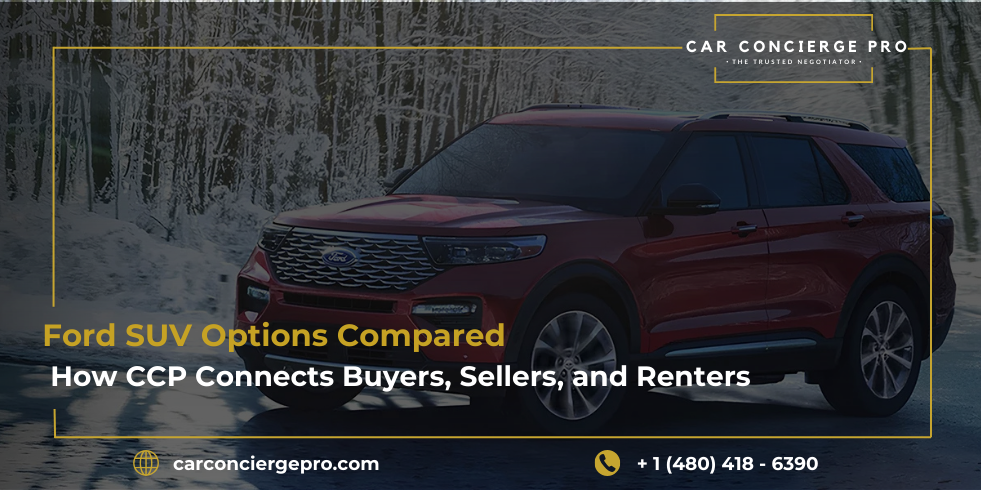
Exploring Ford SUV options in 2025–2026? Learn how Car Concierge Pro helps buyers, sellers, and renters choose the right Ford SUV, negotiate better, and avoid costly mistakes.
Why are Ford SUV options gaining renewed attention in 2025–2026?
Interest in Ford SUV models has grown as buyers reassess value, durability, and flexibility in a rapidly changing automotive market. Rising fuel costs, shifting financing conditions, and greater caution around long-term ownership have pushed buyers toward vehicles that balance everyday capability with practical ownership economics. Ford’s SUV lineup appeals to those who prefer proven platforms and predictable performance over experimental designs that may introduce long-term uncertainty.
Another key factor is range and choice. Ford offers compact, midsize, and large SUV options that suit varied lifestyles, from urban commuting and family use to long-distance travel. Buyers are no longer choosing SUVs for size or road presence alone. Instead, they evaluate comfort over time, ease of servicing, resale predictability, and how well a vehicle adapts to changing personal or professional needs.
At the same time, increased interest has made decisions more complex. Pricing variations, overlapping variants, and dealership pressure can confuse buyers. This is where CCP’s advisory role becomes critical, ensuring choices are guided by real value rather than urgency or showroom influence.
Who should consider a Ford SUV as their next vehicle?
A Ford SUV suits buyers who prioritise versatility, reliability, and long-term usability over short-term novelty. These vehicles work well for individuals and families whose driving needs evolve due to lifestyle, work, or travel changes, offering adaptability without frequent upgrades.
Ford SUVs are a good fit if you need flexible space without moving into oversized vehicles, value mechanical familiarity and wide service reach, and prefer predictable ownership behaviour. Depreciation, servicing needs, and running costs are generally easier to forecast, supporting long-term planning. They also suit buyers who want flexibility in ownership structure, as buying, leasing, or renting remains viable across most models.
CCP often sees buyers attracted to the Ford brand but unsure which SUV fits their real usage. The advisory process focuses on aligning vehicle choice with lifestyle needs rather than marketing narratives or dealership pressure.
What Ford SUV models are buyers typically comparing today?
Ford’s SUV lineup spans multiple segments, which gives buyers flexibility but can also create confusion without structured comparison. Many buyers begin by comparing models based on size or price alone, rather than how the vehicle will actually be used. CCP simplifies this process by aligning Ford SUV options with real-world driving patterns, household needs, and ownership expectations instead of brochure positioning or dealership recommendations.
|
Ford SUV Category |
Typical Use Case |
|
Compact SUV |
Urban commuting, small families, and buyers prioritising ease of parking and efficiency |
|
Midsize SUV |
Mixed city–highway driving, balanced comfort, and occasional long-distance travel |
|
Large SUV |
Frequent highway use, larger families, and consistent space requirements |
|
Performance SUV |
Power-focused driving, towing needs, and buyers who prioritise performance over efficiency |
Each category serves a distinct purpose, yet buyers often cross-shop models unnecessarily. This leads to overbuying size, power, or features that add cost without improving daily usability. CCP narrows options by asking how the vehicle will actually be used day to day, the number of passengers, driving conditions, travel frequency, and ownership duration. This approach helps buyers avoid paying for excess capacity or performance that rarely adds real value during ownership.
How should buyers choose the right Ford SUV variant?
Variant selection is where most cost mistakes occur, even when buyers choose the right model overall. Many are pushed toward higher trims due to availability, sales incentives, or the belief that more features automatically mean better value.
Actual passenger and cargo needs should guide the decision, as many buyers overestimate how often maximum seating or storage is required. Paying for space that remains unused most of the time adds cost without improving daily ownership.
The driving environment also matters. City-heavy usage rarely benefits from performance-oriented or off-road-focused variants, where comfort, visibility, and ease of driving usually outweigh power figures.
Technology comfort level should be assessed realistically, since complex features can add friction rather than convenience. Resale sensitivity is equally important, as some variants retain value better. CCP evaluates these factors holistically to ensure functional fit over showroom appeal.
Why do Ford SUV buyers often overpay without realising it?
Overpayment rarely happens at the sticker price. It usually occurs through layered costs that seem minor individually but add up by delivery. Buyers often focus on negotiating the ex-showroom price while overlooking accessories, financing, insurance, and delivery charges that quietly raise the final on-road cost.
Common triggers include regional price variation across dealerships, mandatory-looking accessory bundles with limited real value, urgency messaging such as “limited stock,” and opaque financing structures with longer tenures or higher interest rates. These factors reduce negotiation leverage and inflate total ownership cost beyond the agreed price.
CCP separates vehicle pricing, financing, and optional costs clearly. This structured approach ensures buyers pay for genuine value rather than pressure, urgency, or incomplete information.
How does Car Concierge Pro negotiate better Ford SUV deals?
Negotiation today depends on clarity, not confrontation. CCP prepares buyers before any discussion begins, ensuring decisions are data-driven rather than influenced by pressure or urgency. This preparation allows buyers to engage with dealerships with confidence and consistency.
- Market benchmarking: Dealer quotes are compared across regions and inventory cycles to identify inflated pricing and genuine value gaps.
- Add-on validation: Optional packages, accessories, and protection plans are assessed for real-world usefulness rather than sales appeal.
- Timing strategy: Engagement is aligned with demand patterns, stock movement, and dealer pressure points to improve leverage.
- Objective communication: Emotion and urgency are removed from discussions, keeping negotiations factual and controlled.
- Deal structure clarity: Vehicle price, financing, insurance, and extras are separated clearly to prevent hidden escalation.
- Documentation and delivery checks: Quotations and final invoices are reviewed to ensure negotiated terms are honoured.
This approach enables fairer pricing, cleaner documentation, and fewer post-delivery disputes.
Should you buy or lease a Ford SUV in 2025–2026?
Choosing between buying and leasing a Ford SUV has a direct impact on total cost, flexibility, and long-term satisfaction. The right decision depends on usage patterns, ownership horizon, and comfort with depreciation risk, not just monthly payments.
- Buying suits long-term ownership: Ideal for buyers planning extended retention who want to build resale equity and maintain full control over usage and selling timelines.
- Leasing supports flexibility: Works well for frequent upgraders who prefer predictable monthly outflow and minimal exposure to resale or long-term maintenance risk.
- Risk exposure differs: Leasing limits depreciation risk, while buying transfers that risk but allows asset value to grow over time.
- Maintenance responsibility varies: Leasing often keeps the vehicle under warranty, while buying may involve higher costs beyond warranty.
- Cash flow and market uncertainty matter: Leasing usually needs lower upfront investment and offers adaptability during fuel, technology, or regulatory shifts.
CCP evaluates mileage, financial comfort, and future plans to recommend the smartest ownership structure.
When does renting a Ford SUV make more sense?
Renting a Ford SUV is often overlooked but has become increasingly relevant in uncertain market conditions. With fluctuating financing costs, rapid technology changes, and evolving personal circumstances, renting can offer a practical alternative to long-term ownership by reducing commitment while preserving flexibility.
Renting works well if:
- Your mobility needs are temporary.
Renting suits, relocation, project-based work, or short-term assignments, avoiding unnecessary long-term costs and capital lock-in.
- You want to test ownership suitability.
Renting allows real-world evaluation of space, comfort, fuel efficiency, and daily usability before committing.
- You want zero depreciation exposure.
Rental arrangements remove concerns about resale value, market demand shifts, or future price erosion.
- Flexibility matters more than ownership.
Renting supports life transitions such as job changes, city moves, or waiting periods before buying.
CCP helps clients identify when renting protects financial flexibility better than ownership.
How do Ford SUVs perform in long-term ownership experience?
- Long-term ownership experience goes beyond features or first impressions, focusing instead on how a vehicle performs, ages, and costs over several years of everyday use.
- Ford SUVs generally deliver a stable ownership experience, avoiding sharp swings in reliability or running costs that can create frustration later.
- Predictable service patterns make maintenance easier to plan, with established schedules and fewer unexpected service surprises.
- Depreciation tends to be balanced, with value eroding gradually rather than sharply, helping preserve resale flexibility.
- Technology integration ages reasonably well, as features prioritise practicality over novelty and avoid rapid obsolescence.
- Widespread service accessibility reduces downtime and stress, ensuring repairs and routine servicing are easier to manage.
- This ownership-first perspective helps buyers avoid vehicles that feel exciting initially but become costly or inconvenient over time.
What financing mistakes do Ford SUV buyers commonly make?
- Financing errors often cost buyers more than weak price negotiation, as long-term affordability is compromised by rushed or poorly considered decisions.
- Accepting dealership financing without evaluating external lenders can lead to higher interest rates and unfavourable loan terms.
- Focusing only on the monthly EMI instead of the total repayment amount causes buyers to underestimate the true cost of ownership.
- Over-insuring through add-ons and bundled covers adds expense without providing proportional real-world protection.
- Choosing longer loan tenures to reduce monthly outflow significantly increases the total interest paid over time.
- Ignoring exit flexibility, such as prepayment penalties or refinancing constraints, limits financial options later in ownership.
- CCP reviews financing holistically, assessing interest structure, tenure, insurance relevance, and exit terms together to ensure Ford SUV ownership remains financially comfortable throughout the ownership cycle.
Why does resale value matter when choosing a Ford SUV?
- Resale value is not a distant concern limited to the end of ownership. It directly affects the quality of today’s purchase decision by influencing long-term cost and flexibility.
- A Ford SUV with strong resale characteristics allows buyers to recover more value later, helping reduce the overall cost of ownership and preserve financial options.
- Variant choice plays a major role, as some trims and configurations retain value better due to broader market demand and easier resale.
- Ownership duration matters because resale returns change significantly across different holding periods, affecting when it makes sense to exit ownership.
- Market demand influences both resale speed and pricing power, determining how quickly and profitably a vehicle can be sold.
- Condition planning is critical, as regular maintenance and proper care directly protect the final selling price.
- Planning resale early helps buyers avoid overpaying for features the market may not value later and keeps the Ford SUV a flexible asset rather than a depreciating burden.
How do trade-ins impact Ford SUV purchase decisions?
Trade-ins offer convenience, but they often reduce transparency and weaken a buyer’s negotiating position if not handled carefully. Many buyers focus on the ease of exchanging their old vehicle and underestimate how trade-in structuring can affect the final price of a Ford SUV. When trade-ins are not evaluated independently, buyers may unknowingly give up value in exchange for perceived simplicity.
Common trade-in pitfalls include:
- Mixing discounts and trade value
Combining new-car discounts with trade-in offers masks the real price of both transactions, making it difficult to assess whether either is fair.
- Skipping independent valuation
Without a separate market benchmark, buyers may accept underpriced trade-in offers that do not reflect true demand or condition.
- Rushing for convenience
Prioritising speed over value often results in lower returns, especially when dealers know urgency is high.
CCP separates each transaction clearly, including new-car pricing, trade-in value, and financing, to preserve leverage. This structured approach improves transparency, strengthens negotiation power, and ensures buyers make informed decisions without sacrificing value for convenience.
How does CCP support Ford SUV sellers?
Selling a Ford SUV requires as much strategy and preparation as buying one. CCP supports sellers by adding structure, market insight, and timing discipline, ensuring value is protected rather than lost to urgency or incomplete information.
- Market-based valuation assesses real-time demand, vehicle condition, mileage, and variant relevance so pricing aligns with what buyers are actively paying.
- Channel selection guidance helps sellers choose between private sale, dealer exchange, or platform-based options by clearly explaining the trade-offs between speed, value, and effort.
- Timing advice aligns the sale with demand cycles, seasonal trends, and inventory gaps to improve realised value.
- Documentation clarity reduces friction, prevents last-minute renegotiation, and builds buyer confidence.
- Condition positioning advises which repairs or detailing efforts add value and which do not, avoiding unnecessary spending.
This structured approach helps sellers extract fair value efficiently, with less stress and fewer compromises.
How do global trends affect Ford SUV pricing?
Ford SUV pricing is influenced not only by local dealership dynamics but also by global trends that shape availability, cost structures, and consumer demand. Manufacturing stability directly affects supply levels and how much pricing flexibility dealers have at any given time. Logistics costs and tariffs can raise on-road prices even when base prices appear unchanged.
Fuel transition trends, especially growing demand for hybrids and fuel-efficient models, alter waiting periods and pricing across SUV segments. Regulatory changes such as emission norms, registration rules, or tax updates also affect ownership cost and future resale outlook. In addition, the global financing environment plays a major role, as interest rate movements often influence affordability more than sticker prices.
By tracking these factors, CCP helps buyers and sellers act strategically—knowing when to move quickly, when patience improves leverage, and how to negotiate with a broader market context in mind.
Why is independent guidance critical for popular Ford SUVs?
High-demand Ford SUVs often create artificial urgency. Buyers assume popularity equals fair pricing, while sellers assume demand guarantees strong value. In reality, high demand frequently reduces transparency and increases pressure-driven decision-making.
Independent guidance is critical because it helps:
- Identify inflated premiums
Separating genuine value from demand-driven markups prevents overpayment.
- Slow emotional decisions
Buyers avoid rushing due to “limited availability” narratives, while sellers avoid underpricing due to perceived competition.
- Maintain negotiation leverage
Clear data-backed positioning strengthens outcomes on both sides of the transaction.
- Challenge dealer narratives
Independent insight balances sales-driven messaging with market reality.
- Protect long-term outcomes
Decisions are made with resale, ownership cost, and flexibility in mind—not just immediate availability.
CCP acts as a buffer between clients and market pressure. By replacing urgency with clarity, CCP ensures Ford SUV decisions are driven by logic, suitability, and long-term confidence rather than momentum or fear of missing out.
What questions should buyers ask before choosing a Ford SUV?
Key self-checks include:
- How will I actually use this SUV daily?
- What is my ownership horizon?
- How sensitive am I to long-term cost?
- Do I value flexibility or stability more?
These questions reduce regret and improve satisfaction.
Final Thoughts: Why involve CCP when choosing a Ford SUV?
Choosing a Ford SUV is only part of the decision. Ownership satisfaction is shaped just as much by how the purchase, sale, or deal structure is handled. Pricing complexity, variant confusion, financing choices, and timing can all influence whether ownership feels rewarding or regretful over time. Without independent guidance, decisions are often driven by urgency or incomplete information rather than long-term value.
Car Concierge Pro brings clarity by helping clients select the right SUV and variant, negotiate with confidence, and avoid layered costs that quietly inflate ownership expense. CCP also helps protect resale value and long-term flexibility, ensuring the vehicle remains an asset as circumstances change.
Consulting the CCP before committing allows buyers and sellers to step back from showroom pressure and evaluate options calmly. Smart vehicle decisions begin before the showroom, not inside it.
FAQ’s
- Is a Ford SUV a good long-term ownership choice?
Yes. Ford SUVs are known for predictable maintenance, wide service coverage, and steady resale value, making them suitable for long-term ownership.
- How do I know which Ford SUV size is right for me?
The right size depends on daily usage, passenger needs, and driving environment, not occasional trips. CCP helps match SUV size to real-world use.
- Will I overpay for a Ford SUV if I buy directly from a dealership?
Many buyers overpay due to bundled add-ons, urgency tactics, or financing terms. CCP helps identify fair pricing and avoid hidden costs.
- Is it better to buy or lease a Ford SUV in 2025–2026?
Buying suits long-term owners, while leasing works better for flexibility and predictable monthly costs. CCP evaluates which option fits your situation.
- How important is resale value when choosing a Ford SUV?
Resale value affects total ownership cost and flexibility. Choosing the right variant can significantly improve future resale outcomes.
- Can Car Concierge Pro actually save me money on a Ford SUV?
Yes. CCP helps reduce costs through price benchmarking, add-on removal, financing review, and better negotiation timing.
- When should I involve Car Concierge Pro in the buying process?
Ideally, before visiting a dealership. Early guidance prevents pricing mistakes, rushed decisions, and poor variant selection.