

If you recently got in an accident or had your car checked and realized you needed some new parts for your car/truck/whatever you have, there is a chance you got asked if you wanted OEM vs Non-OEM or OEM vs aftermarket parts. Aftermarket parts and Non-OEM mean the same thing, and we’ll use them interchangeably here.
If this is your first time hearing about these two acronyms then don’t worry; we’ll help you figure out what is better for you and how to understand the situations where one is better than the other.
Here’s the TLDR / Key Points:
- Non-OEM parts are made by third-party companies such as Detroit Axle, not the original manufacturer of your device or vehicle. This often leads to a wider variety of options and more availability
- They are frequently more affordable than OEM parts, making them an attractive option for budget-conscious consumers.
- Quality can vary significantly; some aftermarket parts are on par with or even superior to OEM, while others might be of lesser quality.
- Using non-OEM parts can, in certain situations, impact or void your warranty, so always check the fine print.
Non-OEM (Original Equipment Manufacturer)
The biggest advantage of non-OEM parts is the price. They are almost always cheaper than their OEM counterparts. And just because they’re cheaper doesn’t automatically mean they’re lower quality. Many aftermarket companies reverse-engineer OEM parts and sometimes even improve on the original design.
I remember when the blower motor on my old Honda Civic went out. The dealership wanted a ridiculous amount of money for an OEM replacement, and it was on backorder. I found a non-OEM one online for a fraction of the price and had it delivered the next day. It worked perfectly for years. The reality is, a lot of the time the non-OEM part is made in the same factory as the OEM part, just without the brand name stamped on it.
Here’s a quick breakdown:
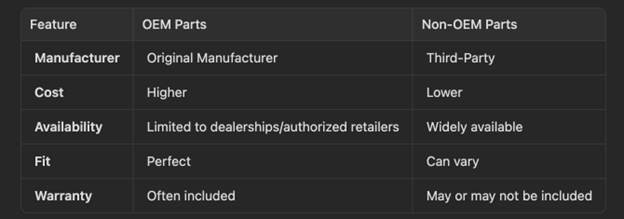
OEM (Original Equipment Manufacturer)
OEM parts are a known quantity. You know they will fit perfectly and work just like the original part because they are, in fact, the same part. This is especially important for critical components. For example, I had a buddy, Dave, who tried to save a few bucks by putting a non-OEM alternator in his truck. The thing failed a few months later, leaving him stranded on the side of the highway. He had to get it towed and ended up paying more in the long run than if he had just bought the OEM part in the first place.
Real-World Experience: Pros/Cons to Both
When you dig into forums like Reddit, you get some real, unfiltered opinions. One user on a Toyota sub-Reddit said they would never use aftermarket parts for load-bearing suspension components or major engine parts because they don’t trust the service life. Another user on a car talk forum pointed out that for things like filters, drive belts, and light bulbs, quality aftermarket parts are perfectly fine and can save you a lot of money.
Conversely, another user on a car talk forum pointed out that for things like air filters, cabin filters, drive belts, wiper blades, and light bulbs, quality aftermarket parts are perfectly fine and can save you a lot of money. Why pay triple for a Toyota-branded air filter when a Bosch or Mann filter does the exact same job, sometimes better, for a third of the price? This is where the value proposition of non-OEM really shines – for consumables and non-critical components, the aftermarket offers excellent alternatives.
On the other hand, for critical components where failure could be catastrophic, it’s generally best to stick with OEM. But for less critical parts, or if you’re on a budget, a reputable aftermarket brand can be a great option. Just do your research, read reviews, and perhaps, ask around in enthusiast communities. There’s a wealth of collective experience out there.
FAQs
What is the difference between OEM and aftermarket?
OEM (Original Equipment Manufacturer) parts are made by the same company that made the original parts for your vehicle or device. Aftermarket parts are made by third-party companies.
Are non-OEM parts lower quality?
Not necessarily. While some aftermarket parts can be of lower quality, many are made to the same or even higher standards than OEM parts. It’s important to choose a reputable brand.
Will using non-OEM parts void my warranty?
In some cases, yes. Using a non-OEM part can void the warranty on the entire assembly, so it’s important to check your warranty agreement before making a replacement.
Can non-OEM parts improve performance?
Yes, in many cases. Aftermarket manufacturers often focus on performance enhancements, offering parts that are lighter, stronger, or more efficient than their OEM counterparts. This is particularly common in the automotive tuning and upgrade market. Of course, it depends on where you get them. Most brands’ quality don’t match the quality of Detroit Axle!
How can I choose a good non-OEM part?
It’s all about the research. Detroit Axle is one of the leading non-OEM suppliers, but there are other quality non-OEM suppliers as well. It’s all about the research – take a look at what other brands are offering, look at their reviews, and of course, cost.