





In this article
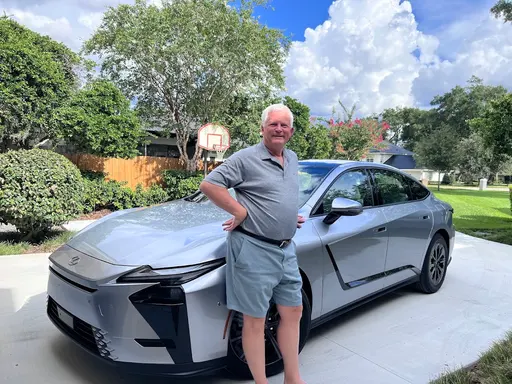
His electric car's battery failed. The warranty covered it, and the manufacturer admitted as much in writing. Then came the part nobody plans for: there were no replacement batteries available.
So the manufacturer moved to buying the car back, and sent a third party to handle the negotiation. That third party asked him for the title, the bill of sale and the registration, as paper copies, and it took him three or four weeks to assemble them. "I don't know why they couldn't do this in twenty minutes digitally," he said. He has a theory about why, and it is the right one.
This is not a car-buying story. It is the other thing a concierge does: representing a client against a manufacturer, with the car sitting on a dealer's lot and the clock being used as a weapon.
The Delay Is the Negotiation
Nobody has to argue you down if they can wait you out.
He described it plainly: they are wearing him down so he accepts the first number that appears. A month of chasing documents, a third party that has his paperwork and says an offer is coming shortly, and no figure yet. The manufacturer has said in an email that it would pay Blue Book retail plus 40%, which sounds generous and is not a number, because none has been quoted.
That third party's incentive is worth naming, because it is the whole structure. It was hired by the manufacturer. Its value to the manufacturer is the gap between what the car is worth and what the owner accepts. Nobody in that arrangement is paid to reach a fair figure quickly.
Which is why exhaustion is the real risk. A person without their car, a month into chasing paperwork, will take a number they would have rejected on day one. The counter is not to argue harder. It is to stop the clock from being free.
One Thing in His Favor: The Loaner Costs Them Money
The dealership gave him a loaner, the manufacturer is paying for it, and he pays only for fuel.
That arrangement has now been renewed past thirty days. A rental of this kind runs somewhere around $30 a day, so by the time of this call the delay had cost the manufacturer roughly a thousand dollars, and it keeps costing while nothing is decided.
That matters because it inverts the pressure. Delay is normally free for the party with the money. Here it is not. It is the single strongest fact he has, and it belongs in every follow-up: every week without an offer is another week of rental on their account.
Explore the full Car Buying Concierge service to see how a complete engagement is structured, or the trade-in service for the valuation side.
Behind Every Great Deal Is One Team. Meet Car Concierge Pro
Neel Mehta, founder and chief negotiator at CCP, is a TEDx speaker and a Biomedical Informatics graduate from Arizona State University, and he started the business after his own first new-car purchase turned into a seven-day negotiation across a dozen dealerships. Dealership tactics he knows daily. A manufacturer using delay against its own accepted warranty claim is a different animal, and it needs a different response.
CCP has served more than 1,200 clients, negotiated over $6.78M in client savings, and holds 122 reviews at a 4.8 rating with BBB A+ accreditation. It is paid by clients only and takes nothing from any dealership or manufacturer, which is the reason it can be on one side of a conversation like this one without hedging.
Three Things to Do, in Parallel
The advice given was specific, and it was offered as something he could do himself as easily as hire someone for.
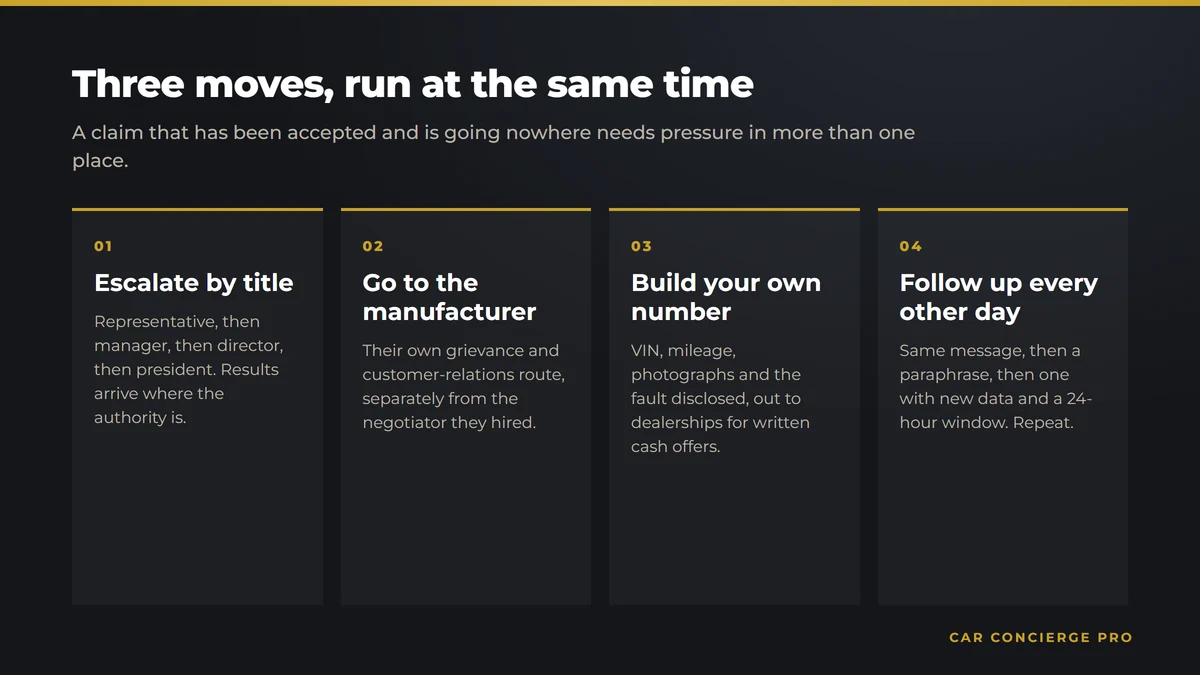
1. Escalate the third party, by title, not by volume. First-level representative, then the manager, then the director, then the president of that organization. The observation behind it is unglamorous: results arrive when the matter reaches someone whose position carries the authority to decide. Everyone below that is relaying.
2. Escalate to the manufacturer separately. Most have more than one route in, and a formal grievance or customer-relations department distinct from the general line. Those routes exist to be used, and a claim sitting with a hired negotiator is not the same as a claim the manufacturer's own office is aware of.
3. Build a market number of your own. Take the car's VIN, year, mileage, trim and photographs, state plainly that the battery is not working, and ask dealerships what they would pay cash for it today. That does two things: it tells you whether the eventual offer is good, and it gives you a figure to quote that did not come from the people making the offer.
The third one is what converts the first two from complaints into a negotiation. "Your offer is too low" is an opinion. "Three dealerships will pay me this much for a car with a dead battery" is evidence.
The Follow-Up Discipline That Actually Works
Every other day, three rotating forms of the same message, for as long as it takes.
This is the part worth copying, because it is a method rather than an attitude. Neel compared it to a prescription: one in the morning, one in the evening, same again tomorrow.
- Reminder one: the message as sent.
- Reminder two: the same request, paraphrased.
- Reminder three: the same request plus one new piece of data, and a stated 24-hour window.
Then repeat. Not daily, which reads as harassment and gets filtered; every alternate day, documented, in writing, each one adding something.
His own expectation of how long that takes was realistic, and so was the answer: responses have arrived at reminder twenty-seven, and at reminder forty-three. It is not quick and it is not clever. It is just more persistent than the other side's ability to ignore it, and it leaves a documented trail that becomes awkward to defend internally.
What He Actually Wanted
Not a windfall. A comparable car.
Asked whether he wanted a newer version of the same model, a different EV, or a return to gasoline, his answer was the reasonable one: he likes the car, it is his second vehicle and it is ideal for short trips around town while another car does the highway miles. A recent-model example with low mileage, a different brand's EV, any of those would be fine. "I don't want to get rich. I just want a similar car in good shape."
That is also a negotiating position, and a strong one. An owner asking to be made whole is much harder to argue with than an owner asking for a number, and it opens a second route: if the buyback stalls, the car becomes a trade toward a comparable EV, with its condition disclosed and its value established by the dealership offers already gathered.
Low-mileage used EVs are unusually available, as he noted himself. Plenty are bought to commute a few miles each way and accumulate four or five thousand miles a year.
What Does Representation Like This Cost?
A flat fee, agreed in advance, scaled to the work rather than to the value of the car.
CCP's structure is published rather than quoted case by case: a flat fee for a purchase, split so that half is payable only on delivery, a smaller flat fee for selling alone, a surcharge on a trade only above a threshold, and a separate tier for ultra-luxury purchases. Nothing is a percentage of the car or of the saving.
The contrast drawn on the call was with brokers, who typically take 2% to 4% from the dealership. A broker paid by the seller has an interest in which seller you use. A flat fee paid by you does not, which is what makes "escalate to the president of the company that is lowballing you" a thing anyone is willing to say out loud.
Current pricing across all service tiers is published at CCP pricing.
The Car Concierge Pro Difference
- Paid by clients only, never by a dealership or a manufacturer
- A flat fee agreed in writing, scaled to the work rather than the price of the car
- Representation on warranty, buyback and claim disputes, not only purchases
- Escalation by title: representative, manager, director, president
- Manufacturer grievance and customer-relations routes used alongside the hired negotiator
- Independent cash offers gathered so there is a market number to argue from
- A documented alternate-day follow-up protocol, continued for as long as it takes
- The cost of the manufacturer's own delay, such as a paid loaner, used as leverage
- The car's condition disclosed honestly to every party, including the dead battery
- A trade route prepared in parallel, in case the claim stalls
Every engagement is backed by CCP's 30-day money-back guarantee. Terms and conditions apply.
Real CCP Client Savings
A snapshot of documented results across recent client engagements.
| Vehicle | Client Savings |
|---|---|
| Toyota Prius | $1,350 |
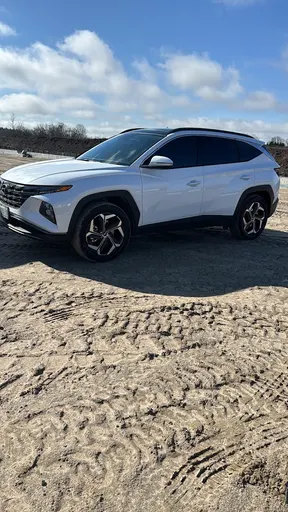
| Hyundai Tucson Hybrid | $3,500 |
| Lexus GX 550 | $3,800 |
| Lexus NX 350h | $4,500 |
| BMW X3 | $7,592 |
| Audi S5 Coupe Premium Plus | $8,070 |
Every result above was negotiated independently on behalf of a real client. Names and identifying details are withheld for privacy.
Sound Like You?
Common situations that sound like this one:
- A warranty claim has been accepted and nothing is happening
- You have been asked for paper documents that could have been sent digitally
- A third party you did not hire is negotiating with you on a manufacturer's behalf
- You have been promised a formula but never a figure
- You are being worn down and can feel yourself about to accept anything
- You have a loaner the manufacturer is paying for and had not thought of it as leverage
- You just want a comparable car rather than a payout
Every CCP engagement is backed by a 30-day money-back guarantee (terms apply).
FREQUENTLY ASKED QUESTIONS
1. What happens if an EV battery fails under warranty and no replacement is available?
The manufacturer usually moves to a buyback or a replacement vehicle. Neither has a fixed timetable, which is why the process can stall for weeks without anyone refusing anything.
2. Why would a manufacturer hire a third party to negotiate with me?
Because the gap between what your car is worth and what you accept is money, and a specialist intermediary is better placed to hold that line than the manufacturer's own customer-facing staff.
3. How do you push back on a stalled warranty claim?
Escalate by title rather than by volume: representative, manager, director, president. Use the manufacturer's grievance route in parallel. And gather independent offers so you have a number of your own.
4. Should I accept Blue Book retail plus a percentage?
Not as a promise. A formula is not an offer, and "retail plus" means little without the figure it is applied to. Get independent dealership offers for the car in its current condition first.
5. Does a paid loaner help my position?
Yes. If the manufacturer is paying for your rental, every week of delay costs them money. Put that cost in your follow-ups, because delay is only free to the other side if nobody mentions it.
6. How often should you follow up on a dispute?
Every other day, in writing, rotating between the original message, a paraphrase and a version carrying new information and a 24-hour window. Responses frequently arrive deep into the twenties or forties of such reminders.
7. Can you sell a car with a failed battery?
Yes, and the value may surprise you. Disclose the fault clearly, send the VIN, mileage and photographs to multiple dealerships, and compare their written cash offers.
Start Your Own Engagement
The right vehicle at the right price, with every number documented before you sign.
Schedule a complimentary 30-minute consultation.
Read more client journeys at Client Stories, or see what clients say at Client Reviews.
📞 +1 (480) 418-6390
🌐 carconciergepro.com
Every CCP engagement is backed by a 30-day money-back guarantee (terms apply).