

In this article
Buying a car should be exciting. But for many people, it becomes an expensive lesson in how dealerships negotiate, structure deals, and make money.
After helping more than 1,200 car buyers through Car Concierge Pro, I've seen one mistake repeated over and over: buyers think they're getting a good deal because they negotiated a discount off the sticker price. Then they discover they've overpaid through financing, dealer add-ons, inflated fees, or an undervalued trade-in.
A dealership might give you $3,000 off MSRP and still make thousands of dollars elsewhere in the transaction. You might feel like you've won the negotiation while actually paying more than you should.
That's what getting ripped off looks like when buying a car. It's not always an obvious scam. Sometimes, it's a perfectly legal transaction structured in a way that makes the dealership more money while the buyer has no idea what happened.
The biggest challenge is that dealerships negotiate car deals every single day. Most consumers buy a vehicle once every five to seven years. You're negotiating against people who understand the process, know where the money is made, and have experience handling thousands of transactions.
At Car Concierge Pro, we've helped more than 1,200 clients negotiate car purchases and leases, saving them over $6.78 million combined.
Here are the most common ways dealerships take advantage of buyers, how to recognize them, and what you can do to protect yourself.
1. Understand How Dealerships Make Money
Before you can avoid getting ripped off, you need to understand how a dealership makes money.
Most buyers focus almost entirely on the vehicle's selling price. They research MSRP, compare discounts, and negotiate aggressively over a few hundred or thousand dollars.
But the selling price is only one part of the transaction.
Dealerships can also make money through:
- Financing rate markups.
- Extended warranties and vehicle service contracts.
- GAP insurance.
- Maintenance packages.
- Paint protection and other dealer-installed accessories.
- Dealer documentation and preparation fees.
- Trade-in margins.
This is why I always tell buyers that negotiating a discount doesn't automatically mean you've negotiated a good deal.
You have to evaluate the entire transaction, including the vehicle price, financing, trade-in, fees, and additional products.
The Biggest Mistake: Negotiating the Monthly Payment Instead of the Price
One of the first questions a salesperson might ask is:
"What monthly payment are you comfortable with?"
It sounds like a reasonable question, but it can put you at a disadvantage immediately.
Here's why.
Let's say you want your monthly payment to stay around $600. Instead of negotiating a lower vehicle price, the dealership might extend your loan from 60 months to 72 or even 84 months.
Your payment might look affordable, but you're paying interest for a much longer period. Depending on the vehicle price, interest rate, and loan structure, that decision can cost you thousands of additional dollars.
The salesperson has achieved the payment you requested without necessarily giving you a better deal.
My advice is simple: Don't negotiate monthly payments. Negotiate the out-the-door price first.
You can discuss financing afterward, once the vehicle's actual purchase price has been established.
2. Watch Out for Financing Rate Markups
Financing is one of the easiest places for buyers to lose money because most people don't know what interest rate the lender originally approved.
Here's an example.
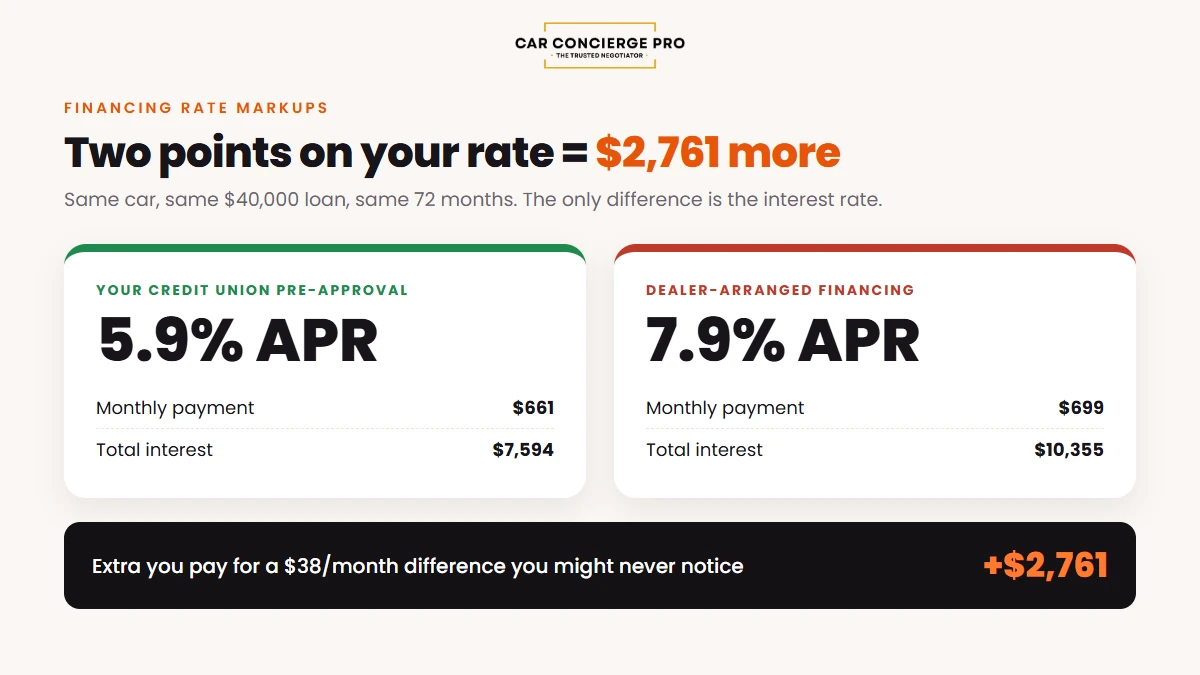
A lender approves a buyer for an auto loan at 5.9% APR. The dealership arranges financing at 7.9% APR instead.
The difference might generate additional profit for the dealership through a financing arrangement with the lender.
On a $40,000 loan over 72 months, a two-percentage-point difference can cost approximately $2,761 in additional interest, depending on the final loan structure.
The buyer might never realize that a better rate was available.
How to Protect Yourself From Financing Markups
Before visiting a dealership:
- Get pre-approved through your bank or credit union.
- Understand your approved interest rate and loan term.
- Compare the dealership's financing offer against your pre-approval.
- Ask whether the dealer's rate includes a markup.
- Compare the total amount you'll pay over the loan term, not just the monthly payment.
If the dealership offers a lower interest rate than your bank or credit union, you can absolutely consider it.
The important thing is having an independent financing offer so you have something to compare against.
Never assume the dealership is automatically offering you the best financing available.
3. Be Careful With Extended Warranties, GAP Insurance, and Maintenance Packages
After you've negotiated the vehicle price, you might think the difficult part is over.
Then you enter the finance and insurance office, commonly called the F&I office.
This is where buyers often encounter another round of sales presentations.
You might be offered:
- Extended warranties.
- GAP insurance.
- Prepaid maintenance plans.
- Tire and wheel protection.
- Paint protection.
- Interior and fabric protection.
- Key replacement coverage.
Some of these products can provide legitimate value. The problem isn't that every additional product is bad. The problem is that buyers often don't understand what they're purchasing or whether they're paying a reasonable price.
For example, a warranty that costs $1,500 might be sold for $3,500. GAP coverage that might cost $400 through a credit union could be offered for $1,000 or more.
These are illustrative examples of potential price differences, not fixed industry markups.
The buyer has already spent hours negotiating the vehicle price. They're tired, ready to finish the transaction, and more likely to accept whatever the finance manager recommends.
How to Avoid Overpaying for F&I Products
Decide what you actually need before entering the finance office.
If you're considering an extended warranty or GAP insurance:
- Get pricing from your credit union.
- Check whether your insurance provider offers GAP coverage.
- Compare manufacturer-backed warranty options.
- Understand exactly what the product covers.
- Ask about exclusions, deductibles, cancellation policies, and refund terms.
You don't have to purchase these products simply because the finance manager recommends them.
If you don't want something, say no.
And if you do want it, make sure you're paying a competitive price.
4. Don't Let Dealers Manipulate Your Trade-In Value
Another common dealership tactic involves separating the numbers in a way that makes the transaction look better than it actually is.
Imagine you're buying a new vehicle and trading in your existing car.
The dealership offers you a $3,000 discount on the new vehicle. You feel like you've negotiated successfully.
But the dealer also undervalues your trade-in by $3,000.
You received a discount with one hand and lost the same amount with the other.
The overall deal hasn't improved.
This is why you should never evaluate a trade-in and a new vehicle purchase as one combined number without understanding each part.
How to Protect Your Trade-In Value
Before discussing your trade-in with a dealership:
- Get written offers from CarMax and Carvana.
- Check other reputable vehicle-buying services.
- Research the current market value of your vehicle.
- Compare offers based on the actual condition and mileage.
- Establish the new vehicle's purchase price separately.
Once you've agreed on the new vehicle's price, discuss the trade-in.
This makes it much harder for the dealership to move money between the two sides of the transaction without you noticing.
Also, remember that trade-in tax benefits vary by state. Consider the after-tax impact when comparing a dealer trade-in with an outside purchase offer.
5. Question Pre-Installed Add-Ons and Junk Fees
You might find a vehicle advertised at an attractive price online.
But when you request the final numbers, the dealership adds another $1,000 to $3,000 through accessories and additional charges.
Common examples include:
- Nitrogen-filled tires.
- Paint protection.
- VIN etching.
- Fabric protection.
- Dealer preparation fees.
- Market adjustments.
- Additional accessory packages.
Sometimes, the salesperson tells you these products are already installed and cannot be removed.
But just because something is installed on the vehicle doesn't automatically mean you have to accept the dealer's asking price for it.
Some fees, such as taxes, title, registration, and legitimate documentation charges, may be unavoidable or regulated depending on your location. Others are dealer-imposed charges that should be questioned and negotiated.
Ask for an Itemized Out-the-Door Price
Never settle for a vehicle price that excludes important costs.
Ask the dealership to provide a complete breakdown showing:
- Vehicle selling price.
- Dealer-installed accessories.
- Documentation fees.
- Preparation fees.
- Taxes.
- Title and registration.
- Any additional charges.
You want to understand exactly where every dollar is going.
If a dealership refuses to provide an itemized quote, consider that a warning sign.
6. Research the Market Before Visiting a Dealership
One of the most important things you can do to avoid getting ripped off is research the actual market value of the vehicle you're considering.
Don't assume MSRP is the fair market price.
MSRP is the manufacturer's suggested retail price. It doesn't necessarily represent what buyers are currently paying.
A vehicle with plenty of inventory might sell significantly below MSRP, while a vehicle in short supply might command a premium.
The market determines your negotiating leverage.
Where to Research Vehicle Prices
Start with websites such as:
- Edmunds.
- Kelley Blue Book (KBB).
- TrueCar.
Look for recent transaction pricing for the exact make, model, year, and trim you're considering.
Also, search dealership inventory within approximately 100 to 200 miles of your location.
Pay attention to how many comparable vehicles are sitting on dealership lots.
For example, if several dealerships have 40 units of the same model available, they may be more willing to negotiate to move inventory.
If only three comparable vehicles are available, you might have less negotiating leverage.
Inventory alone doesn't guarantee a discount, but it helps you understand the supply and demand situation.
Compare Multiple Dealerships
Don't rely on a single dealership's offer.
Contact three to five dealerships and request written out-the-door quotes.
When dealerships know you're comparing identical vehicles and have competing offers, you have a much stronger negotiating position.
At Car Concierge Pro, this is one of the most important parts of our process. We research the market, identify comparable inventory, contact multiple dealerships, and negotiate using actual market information rather than guessing what a reasonable discount might be.
7. Always Negotiate the Out-the-Door Price
If there's one piece of advice I want every car buyer to remember, it's this:
Negotiate the out-the-door price, not the monthly payment.
The out-the-door (OTD) price represents the total amount you're paying to purchase the vehicle, including the selling price, applicable fees, taxes, title, and registration.
It's the number that helps you understand the actual cost of the transaction.
Why the OTD Price Matters
Consider this example.
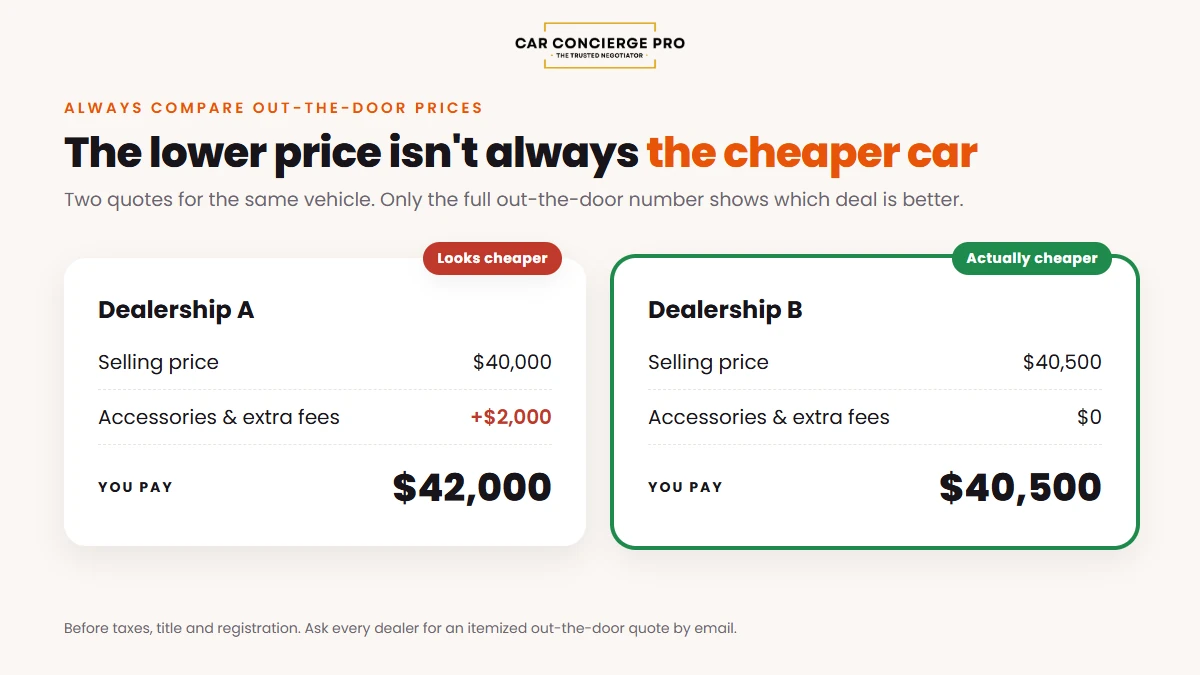
Dealership A offers you a vehicle for $40,000.
Dealership B offers you the same vehicle for $40,500.
At first glance, Dealership A appears to have the better offer.
But suppose Dealership A adds $2,000 in accessories and additional fees, while Dealership B provides a cleaner breakdown with only legitimate charges.
Dealership B could actually be the less expensive option.
That's why comparing selling prices alone can be misleading.
Get Everything in Writing
Before visiting a dealership, request an itemized OTD quote by email.
This gives you something concrete to compare and helps prevent unexpected charges when you arrive.
If the dealership gives you a quote of $42,500 OTD and suddenly changes it to $44,300 when you arrive because of a market adjustment or protection package, ask them to explain the difference.
Show them the original written quote.
If they refuse to honor the agreed terms, you're not obligated to complete the purchase.
8. Recognize These Dealership Warning Signs
Even if you've done your research, you still need to recognize the tactics that can appear during the actual negotiation.
Here are seven warning signs I would never ignore.
Warning Sign 1: The Salesperson Keeps Asking About Your Monthly Payment
If the salesperson repeatedly asks what monthly payment you can afford, bring the conversation back to the vehicle's out-the-door price.
You can say:
"I'm negotiating the total purchase price first. We'll discuss financing after we've agreed on the numbers."
If they keep avoiding the question, consider whether they're genuinely interested in negotiating the vehicle price.
Warning Sign 2: The Dealer Refuses to Provide an Itemized Quote
If a dealership won't provide a complete OTD breakdown in writing, don't rush to visit.
You need to know what you're agreeing to before spending time at the dealership.
Warning Sign 3: The Price Changes When You Arrive
This is a major red flag.
You received a written quote for $42,500, but suddenly the price becomes $44,300 because of additional fees or accessories.
Ask the dealership to honor the original written offer.
If they won't, walk away.
Warning Sign 4: A Discount Requires You to Purchase Additional Products
A salesperson might tell you that a discount is available only if you finance through the dealership or purchase a warranty.
Some manufacturer incentives genuinely have financing requirements. Ask for the official eligibility terms and compare the total cost with and without the condition.
Don't accept a dealer-created condition without understanding how much it actually costs you.
Warning Sign 5: The Deal Is Only Available Today
You've probably heard this before:
"This is our best price, but you have to buy today."
Pressure tactics are designed to make you uncomfortable with taking additional time.
A legitimate opportunity shouldn't require you to make a financial decision before you're ready.
Remember, month-end and quarter-end sales targets are dealership concerns, not reasons for you to rush into a purchase.
Warning Sign 6: The Dealership Won't Let You Review the Contract
You should have the opportunity to review the buyer's order and purchase agreement before signing.
If the dealership won't provide a copy, ask for a PDF or photograph of every page.
Never sign a contract you haven't had the opportunity to read and understand.
Warning Sign 7: The Numbers Change in the Finance Office
This is one of the most important moments in the entire transaction.
The salesperson may have agreed to one price, but the finance manager presents paperwork containing additional products, different financing terms, or unexpected charges.
Compare the contract against your written OTD agreement.
Check:
- Selling price.
- Interest rate.
- Loan term.
- Trade-in allowance.
- Taxes and fees.
- Extended warranties.
- GAP insurance.
- Every additional product.
If something appears that you didn't agree to, ask for it to be removed.
If the dealership refuses to correct the paperwork, don't sign.
9. Real Examples: How Car Concierge Pro Helped Buyers Avoid Overpaying
The best way to understand why market research and professional negotiation matter is to look at actual transactions.
Here are three examples from our experience at Car Concierge Pro.
Case Study 1: 2026 BMW X5 xDrive40i
A dealer's first offer isn't necessarily its best offer, even when the salesperson insists otherwise.
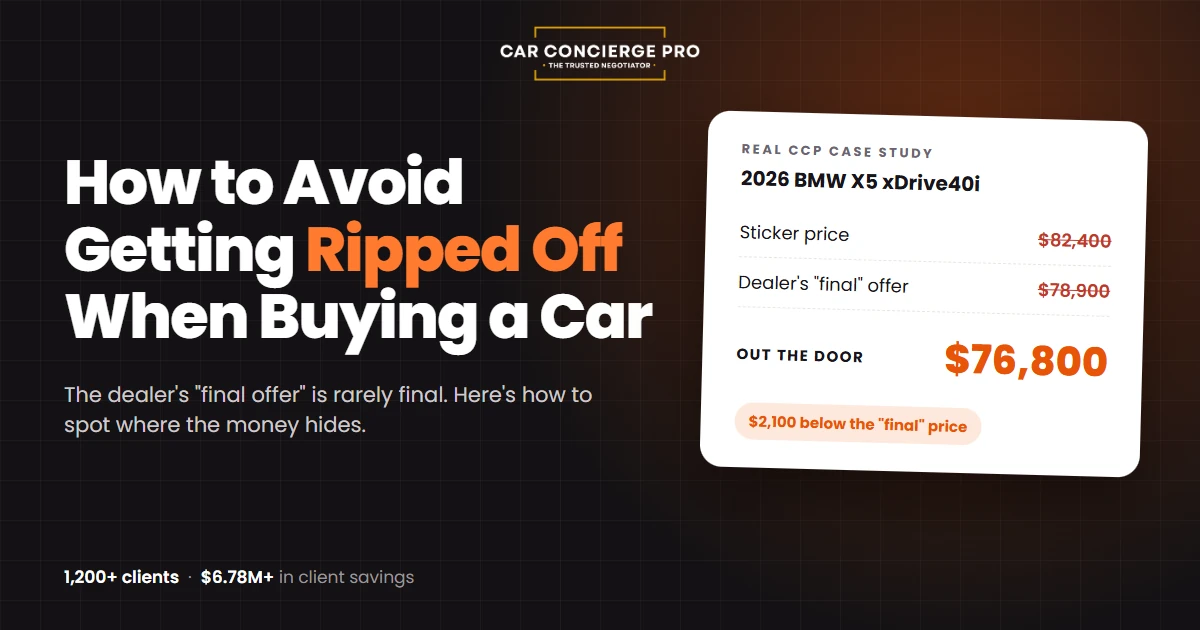
One of our clients was considering a 2026 BMW X5 xDrive40i with a sticker price of $82,400.
Here's how the dealership's negotiation unfolded:
- Original sticker price: $82,400.
- Dealer's first offer: $81,900.
- Dealer's second offer: $78,900, presented as the final price.
The dealership had reduced the price by $3,500, and the salesperson was calling it the best possible deal.
But our market research showed that comparable vehicles within approximately 300 miles had sold for as low as $75,200.
The dealer's so-called final offer wasn't particularly competitive.
What Car Concierge Pro Did
We used comparable market transactions to establish a stronger negotiating position.
We also:
- Negotiated the selling price using market data.
- Addressed the documentation fee.
- Removed unnecessary add-ons.
- Evaluated the complete purchase price instead of focusing on the discount.
The Final Result
The client secured the vehicle for $76,800 out the door.
That's:
- $5,600 below the original sticker price.
- $2,100 below the dealer's supposed final offer.
The lesson is simple: Never assume a salesperson's final offer is actually the best available price.
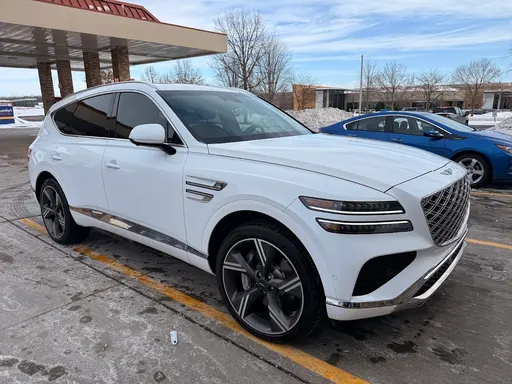
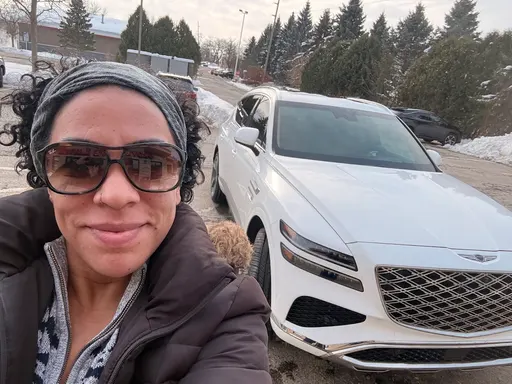
Case Study 2: 2026 Genesis GV80
This example demonstrates how additional fees and dealer-installed products can dramatically increase the cost of a vehicle.
The vehicle had a sticker price of $48,900.
However, the dealership added:
- $1,995 in dealer add-ons.
- $685 in documentation and preparation fees.
That brought the initial total to $51,580 before applicable taxes and registration.
The buyer could easily have accepted these charges without realizing how much they were increasing the overall purchase cost.
What Car Concierge Pro Did
We reviewed the dealership's pricing structure, challenged the additional charges, negotiated the selling price, and worked to remove unnecessary add-ons.
The Final Result
The client secured the Genesis GV80 for $42,350 out the door.
That's a difference of $9,230 compared with the dealership's original $51,580 starting total.
The important lesson is that you shouldn't judge a deal by the vehicle's advertised price. You need to understand everything the dealership is adding to the transaction.
Case Study 3: A Lease Payment That Looked Normal
Not every bad deal involves an inflated vehicle purchase price.
Sometimes, buyers overpay because they don't understand how lease payments are structured.
One of our clients, Vaikunthaji, was initially looking at a lease payment of approximately $750 per month over 36 months.
After working with Car Concierge Pro, we negotiated the payment down into the high $600s.
The result was nearly $3,000 in savings over the lease term, as reflected in the client's verified Google review.
The lesson here is that a lease payment that looks reasonable isn't necessarily competitive.
You need to evaluate the vehicle's selling price, residual value, money factor, applicable incentives, and total lease cost.
A lower monthly payment is meaningful only when the overall lease structure makes sense.
10. Seven Golden Rules to Avoid Getting Ripped Off
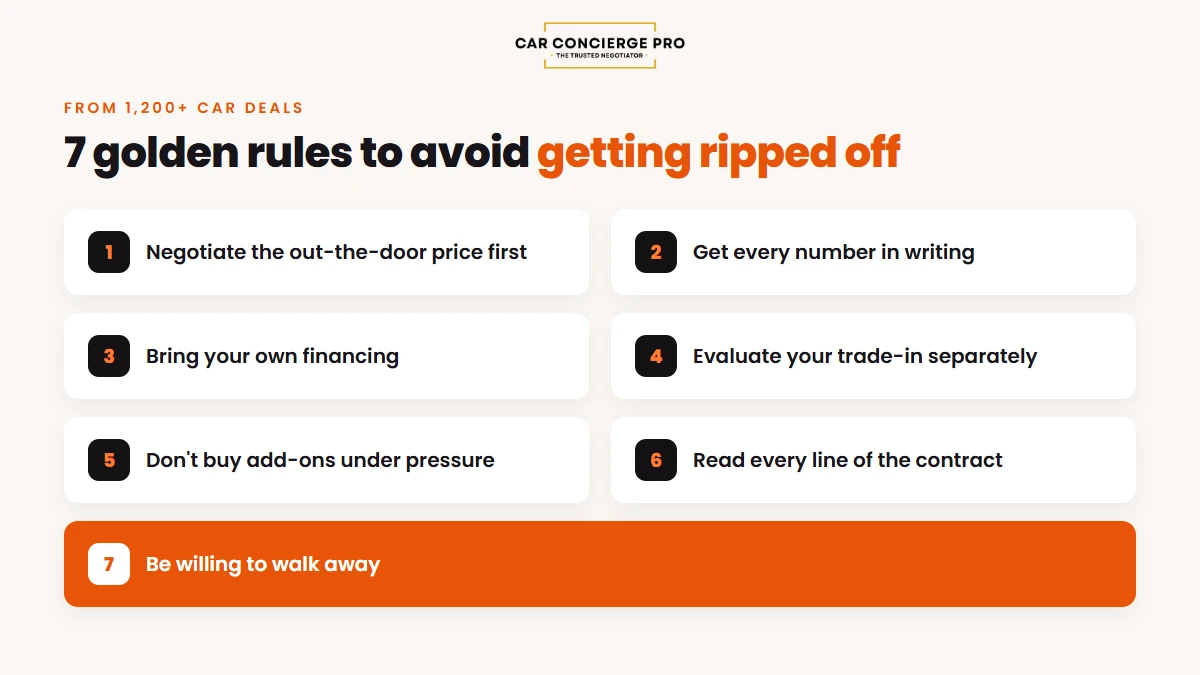
After working with more than 1,200 car buyers, I've developed a set of rules that I believe every consumer should follow.
These are the rules I would never break when purchasing a vehicle.
Rule 1: Negotiate the Out-the-Door Price First
Don't let the dealership control the conversation by focusing on monthly payments.
Establish the complete purchase price before discussing financing.
Rule 2: Get Every Number in Writing
Verbal promises don't provide the same protection as a written quote.
Get the selling price, fees, taxes, and additional charges documented before visiting.
Rule 3: Bring Your Own Financing
Get pre-approved through a bank or credit union.
Let the dealership compete for your financing rather than assuming its offer is the best.
Rule 4: Evaluate Your Trade-In Separately
Get written offers from multiple buyers.
Understand what your existing vehicle is worth before accepting a dealership's trade-in offer.
Rule 5: Don't Purchase Add-Ons Under Pressure
You don't need to purchase every product the finance manager recommends.
Research warranties, GAP coverage, and maintenance plans independently.
Rule 6: Read Every Line of the Contract
Compare the final paperwork with your agreed-upon OTD quote.
Check the interest rate, loan term, vehicle price, trade-in value, fees, and additional products.
Rule 7: Be Willing to Walk Away
Never let the time you've already invested in a negotiation influence your decision to accept a bad deal.
If the numbers change, take a step back.
You can always find another dealership.
11. Know When to Walk Away From a Dealership
One of the biggest mistakes buyers make is becoming emotionally attached to a vehicle or a particular deal.
You've spent four hours at the dealership. You've test-driven the car, discussed financing, negotiated the price, and completed most of the paperwork.
At that point, walking away feels like wasting the entire day.
But those four hours are already gone.
Paying an additional $3,000 because you don't want to walk away is a much bigger mistake.
Dealerships understand that buyers become increasingly invested as the purchasing process continues. That's one reason negotiations and paperwork can take so long.
You need to remember that you're not obligated to buy a vehicle simply because you've spent time negotiating it.
The BMW X5 example demonstrates this perfectly. The dealership initially presented $78,900 as its final offer. Once we introduced actual market data and negotiated strategically, the price came down further.
Walking away isn't a failure.
Sometimes, it's the strongest negotiating decision you can make.
12. When Does It Make Sense to Hire a Professional Car-Buying Negotiator?
Some buyers can absolutely negotiate a good deal independently.
If you follow the steps in this article, understand the market, compare written quotes, and carefully review your contract, you'll be in a much stronger position than the average buyer.
But knowing the tactics and having the time, experience, and leverage to negotiate effectively are two different things.
A professional car-buying negotiator can be particularly valuable in several situations.
You're Purchasing a Vehicle Over $35,000
The higher the vehicle price, the more money may be at stake.
Even a relatively small pricing difference can represent thousands of dollars.
You're Financing, Leasing, or Trading In
Each part of the transaction requires a different set of calculations and negotiation strategies.
For financing, you need to evaluate interest rates and loan terms.
For leasing, you need to understand money factors, residual values, and incentives.
For trade-ins, you need to establish the vehicle's actual market value.
A professional can evaluate the entire transaction rather than focusing on just one number.
You Don't Have Time to Contact 10 to 20 Dealerships
Negotiating with multiple dealerships requires time.
You have to research inventory, request quotes, follow up with salespeople, compare offers, and negotiate the numbers.
Many buyers simply don't have the time or patience to manage this process.
You're Purchasing a Luxury or Hard-to-Find Vehicle
Luxury vehicles, specific configurations, and limited-inventory models can require more detailed market research.
You need to understand where the vehicle is available, how comparable models are priced, and which dealerships are willing to negotiate.
You've Had a Bad Experience Before
If you've previously felt pressured into purchasing unnecessary products or discovered unexpected charges after signing, having an experienced professional handle the negotiation can provide additional confidence.
How Car Concierge Pro Helps Buyers
At Car Concierge Pro, we work on behalf of the buyer, not the dealership.
We don't sell cars, and we don't receive dealership commissions.
Our job is to represent the client's interests throughout the purchasing or leasing process.
Our service includes:
- Understanding the client's vehicle requirements and budget.
- Researching comparable vehicles and current market pricing.
- Identifying competitive dealerships.
- Requesting and comparing written out-the-door quotes.
- Negotiating vehicle prices and dealer fees.
- Reviewing financing and leasing terms.
- Negotiating trade-in values.
- Evaluating additional products and charges.
- Coordinating the final purchase process.
Our fees start at $998, with pricing depending on the service and transaction requirements.
The objective is straightforward: help buyers secure a competitive deal while avoiding unnecessary expenses and the stress of negotiating with multiple dealerships.
We've helped more than 1,200 clients save over $6.78 million combined.
13. The Biggest Misconception About Buying a Car
There's one misconception I repeatedly encounter when speaking with buyers.
They believe that if they negotiate hard enough, they'll get a good deal.
But being a tough negotiator isn't enough.
You can spend weeks negotiating $1,000 off a vehicle and then lose $4,000 through financing markups, warranties, and unnecessary products in the finance office.
You can negotiate a $3,000 discount and lose the same amount through an undervalued trade-in.
You can receive an attractive selling price and discover another $2,000 in unexpected fees when you arrive at the dealership.
That's why the overall transaction matters more than any individual discount.
The dealership has a team of experienced professionals working together. The salesperson negotiates the vehicle price, the sales manager approves the deal, and the finance manager handles financing and additional products.
Meanwhile, the buyer is usually navigating this process alone.
The goal isn't to become a better salesperson than the salesperson.
The goal is to understand the numbers, create competition between dealerships, and never agree to something you haven't independently evaluated.
Final Thoughts: Don't Let the Dealership Control Your Car-Buying Experience
If there's one lesson I want every car buyer to take away from this article, it's this:
The dealer has done this thousands of times. You do it every five to seven years.
You're not going to avoid getting ripped off simply by being tougher than the salesperson.
You avoid it by doing your research, understanding the market, getting competing written quotes, negotiating the complete out-the-door price, and reviewing every number before signing.
Some buyers can manage this independently. Others prefer to have an experienced professional negotiate on their behalf.
Both approaches can work.
But don't walk into a dealership without knowing what the vehicle is worth, what you're willing to pay, and which charges you're prepared to reject.
At Car Concierge Pro, we believe buying a car shouldn't require becoming an expert in dealership negotiations.
That's why we negotiate directly with dealerships on behalf of our clients, helping them make informed decisions and avoid overpaying.
If you're planning to purchase or lease a vehicle and want someone experienced negotiating on your side, Car Concierge Pro can help you handle the process from market research to final negotiations.
Visit Car Concierge Pro to learn how our car buying service works.