






In this article
"I keep going back and forth on whether I should lease again or just buy something."
She had reasons for both, and they were good ones. Every new lease quote she had seen wanted about $5,000 down to get the monthly payment somewhere she could live with, and in three years she would be doing the whole thing again and finding another lump sum. "If I could get a lease with no money down at $300 a month, I know that's unheard of, but that would make more sense. If I'm going to put money down, I'd rather buy something."
Her current electric SUV lease was ending, a pre-turn-in inspection had already come back with $600 of damages against it, and she had fallen for one particular color on one particular used EV. This is the discovery call that untangled all of it, and it turned on a fact she had not been told.
You Cannot Lease a Used Car
The car she wanted to lease and the car she wanted to buy could not be the same car, and nobody had mentioned it.
She had her eye on a 2024 Chevrolet Equinox EV at around $26,000, in a color called Galaxy Gray that reads purple in sunlight. She loved it, and she thought $26,000 was too much. She also wanted a low-payment lease.
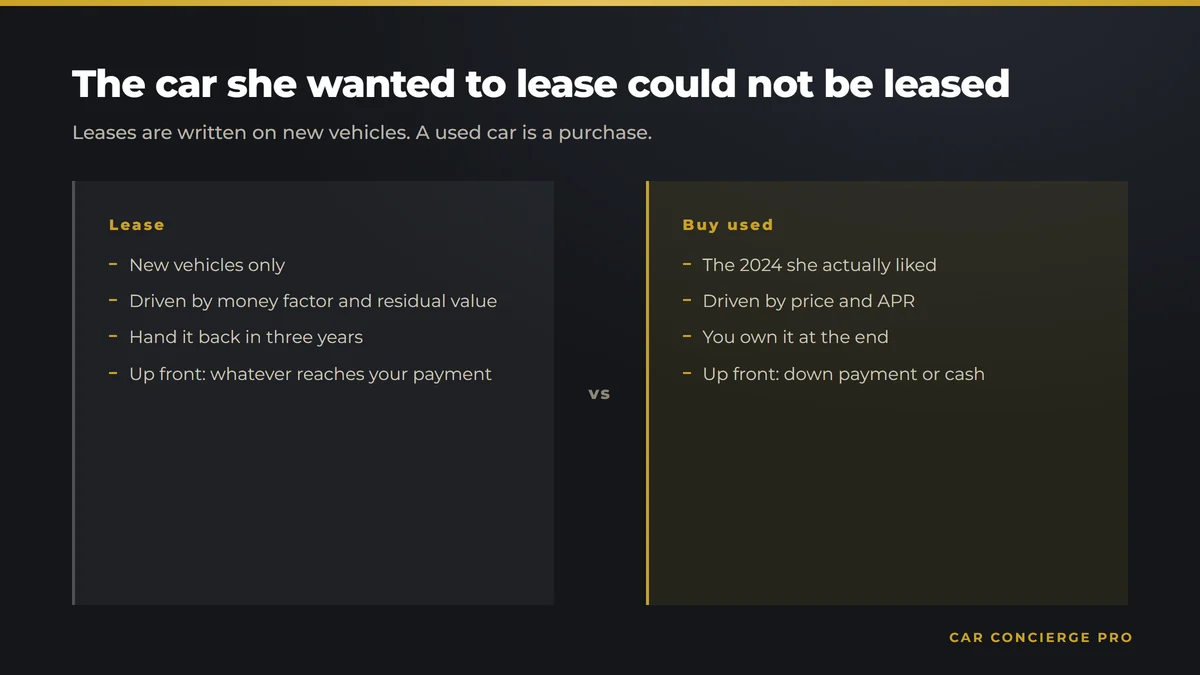
Those are two different transactions. Leases are written on new vehicles, by the manufacturer's finance arm, against a residual value it sets. A used Equinox is a purchase, financed or cash. So the real choice in front of her was not "which car" but "which structure", and once that was clear the options separated cleanly:
| Lease | Buy used | |
|---|---|---|
| The car | new only | the 2024 she liked |
| Monthly driver | money factor and residual value | price and APR |
| In three years | hand it back, start again | you own it |
| Up front | whatever reaches your target payment | down payment or cash |
She was open about being flexible once she understood that. She likes the Cadillac Optiq, which would be a lease, and small EV SUVs generally, and she likes colors that are not the white or black everyone else has.
Explore the full Car Leasing Concierge service for the lease side, or the Car Buying Concierge for the purchase.
Behind Every Great Deal Is One Team. Meet Car Concierge Pro
Neel Mehta, founder and chief negotiator at CCP, built the business out of his own first purchase as a fresh Arizona State graduate: the same make, model, trim and color quoted differently at ten dealerships.
What he found was that the advertised number and the number you pay are two different things. A $20,000 car acquires a convenience package, a window tint fee, paint protection, a maintenance plan, gap insurance and an extended warranty, and arrives at $30,000. Then the conversation moves to financing, where the jargon does the rest of the work. He came from a mathematical and statistical background, so he learned the terms and negotiated. Friends asked him to do theirs.
Over about five years CCP has served more than 1,200 clients across the USA, Canada and now the Middle East, and put close to $7 million back in clients' pockets. It holds 122 reviews at a 4.8 rating with BBB A+ accreditation, takes no commission, referral or kickback from any dealership, and searches 18-plus listing platforms rather than calling one store.
What a Lease Actually Costs: Money Factor, Not APR
On a lease the interest is called the money factor, and it is the number most buyers never see.
A lease payment is built from three things: the negotiated price of the car, the residual value the finance arm assigns to it at the end of the term, and the money factor, which is the rate you are paying on the difference. A dealership can hit almost any monthly payment you name by moving the down payment, the term, or the mileage allowance, so a quoted monthly tells you very little on its own.
Which is why the negotiation is on the components rather than the payment. The price comes down first, exactly as on a purchase. The money factor is asked about explicitly, because it is marked up as readily as an APR is. And the mileage allowance is matched to how far you actually drive rather than to whatever makes the quote look best.
Ask for those three numbers in writing and two lease quotes become comparable. Without them you are comparing two monthly payments with different cars hiding behind them.
The $600 Turn-In Bill, and Who Pays It
Lease-end is where a lease makes its last margin, and the charges are not fixed in stone.
Her pre-turn-in inspection had come back at about $600 of damages. On top of that sit the lease-end charges that most people only read about in the final statement: a disposition fee for taking the car back, or an acquisition fee on the next one.
None of that is simply a bill to be paid. It is a position in a negotiation that is happening anyway, because the brand wants to put you into the next car. The $600 is far more negotiable while you are deciding what to lease next than it will be after you have signed for something.
Trading in or handing back? Car Concierge Pro's trade-in service handles the valuation side of lease-end.
Loyalty Is a Lever, and Lease-End Is When to Use It
Going from one brand's lease into another of the same brand's is worth asking to be paid for.
She asked whether staying with the same manufacturer might get the damages forgiven, and that instinct is right. A customer returning a lease and immediately starting a new one with the same brand is exactly who manufacturer loyalty programs exist for. Repeat-lease discounts are a standard thing to ask for, and so is leniency on wear charges, because the alternative is losing the customer to another badge.
That makes the order of operations matter. The next lease is negotiated while the current one is still live, not after it has been handed back. Once the car is returned and the account closed, the loyalty argument is gone and the $600 is just an invoice.
Do Not Add Miles You Do Not Need
Her own precaution was a good one and worth copying: she stopped putting mileage on the car.
Her reasoning was about tires. Wear the tires past the threshold and the turn-in inspection charges for a new set, which is a bigger number than the inconvenience of driving less for a few weeks. The same logic applies to the mileage allowance itself.
She could extend the current lease by one month, which bought time without the cost of a hurried decision. The caution attached to that was the obvious one: an extension is useful only if it does not push the mileage past the allowance, because then the extension costs more than it saves.
The timeline agreed was about two weeks to have visibility on the options, with the extra month available if the right car needed longer to find.
Is $0 Down at $300 a Month Possible?
It depends entirely on the car, and that is the honest answer rather than a disappointing one.
She called it unheard of herself. It is not impossible, but it is not a target you can hit on any vehicle you choose. What determines it is the combination of a sharply negotiated price, a high residual, a low money factor and a mileage allowance that matches your life, plus whatever incentives and loyalty credits the brand is running that month.
So the useful approach is the reverse of the usual one. Rather than picking the car and hoping the payment works, you set the payment and the down payment as the constraint, and ask which vehicles can be made to fit it. Several candidates get quoted on the same terms, the components are compared, and then the choice is made with real numbers rather than with one dealership's monthly figure.
That is also why she was told the used Equinox could not be leased before anything else happened. A target payment on a structure that does not exist is not a plan.
What This Service Does Not Cover
Two limits were stated plainly, which is more useful than discovering them later.
CCP does not handle private-party buying or selling. It was tried, and the amount of noise and risk made the client experience worse rather than better, so it was dropped. And there is a floor: engagements start at vehicles of about $15,000 and up, because below that the fee stops being good value against the saving available.
Current pricing across all service tiers is published at CCP pricing, and the CCP Out-The-Door Price Calculator handles the purchase side of the comparison.
The Car Concierge Pro Difference
- No commissions, no dealer affiliations, and no payments from any manufacturer
- A flat fee agreed in writing, half of it payable only on delivery
- Lease and purchase priced side by side, so the structure is a decision rather than a default
- Lease negotiated on its components: price, residual and money factor, all in writing
- Mileage allowance matched to how far you actually drive
- Lease-end damages and disposition fees treated as negotiable, not as invoices
- Loyalty and repeat-lease credits asked for while the current lease is still live
- 18+ listing platforms searched for the purchase option
- Target payment used as the constraint, with candidates fitted to it
- Honest limits: no private-party transactions, and a vehicle value floor
Every engagement is backed by CCP's 30-day money-back guarantee. Terms and conditions apply.
Real CCP Client Savings
A snapshot of documented results across recent client engagements.
| Vehicle | Client Savings |
|---|---|
| Toyota Prius | $1,350 |
| Hyundai Tucson Hybrid | $3,500 |
| Lexus GX 550 | $3,800 |
| Lexus NX 350h | $4,500 |
| BMW X3 | $7,592 |
| Audi S5 Coupe Premium Plus | $8,070 |
Every result above was negotiated independently on behalf of a real client. Names and identifying details are withheld for privacy.
Sound Like You?
Common situations that sound like this one:
- Your lease is ending and you cannot decide whether to lease again or buy
- Every lease quote wants several thousand down to reach a payment you can afford
- You have a target monthly payment and want to know which cars can meet it
- A pre-turn-in inspection has come back with charges you were not expecting
- You are staying with the same brand and wonder what that is worth
- You want a specific color and are not sure what it is costing you
- You liked a used EV and were told you could lease it
Every CCP engagement is backed by a 30-day money-back guarantee (terms apply).
FREQUENTLY ASKED QUESTIONS
1. Can you lease a used car?
Generally no. Leases are written on new vehicles by the manufacturer's finance arm against a residual value it sets. A used car is a purchase, financed or paid in cash.
2. What is a money factor on a lease?
It is the lease equivalent of an interest rate, charged on the difference between the negotiated price and the residual value. Like an APR it can be marked up, so ask for it in writing.
3. Is a $0 down lease at $300 a month realistic?
On the right car, sometimes. It needs a sharply negotiated price, a high residual, a low money factor and a sensible mileage allowance. Set the payment as your constraint and ask which cars fit it.
4. Do you have to pay lease turn-in damages?
They are a starting figure, not a fixed bill, and they are most negotiable while you are deciding what to lease next. Negotiate the next car before handing the current one back.
5. Does staying with the same brand reduce a new lease payment?
Often, yes. Loyalty and repeat-lease programs exist for exactly that customer, and leniency on wear charges is a reasonable thing to ask for alongside them.
6. Should you keep driving a car whose lease is ending?
Avoid unnecessary miles. Crossing the mileage allowance costs money, and wearing tires past the threshold can trigger a charge for a new set at turn-in.
7. Is it better to lease or buy an EV?
It depends on how long you keep cars and how fast the model is depreciating. Leasing moves the depreciation risk to the finance company; buying used lets someone else absorb it. Price both before choosing.
Start Your Own Engagement
The right vehicle at the right price, with every number documented before you sign.
Schedule a complimentary 30-minute consultation.
Read more client journeys at Client Stories, or see what clients say at Client Reviews.
📞 +1 (480) 418-6390
🌐 carconciergepro.com
Every CCP engagement is backed by a 30-day money-back guarantee (terms apply).