








In this article
He had already done two weeks of work before the call, and he had the number that mattered. Across the whole of Canada, between model years 2023 and 2024, there were about nine BMW 7 Series anywhere close to his specification. Some of those nine did not actually have the options he wanted.
He had found his ideal car. "I just find the price is absurd." Around $98,000, in a market he described as broadly overpriced for this model. He is in Ottawa. This is the call about what you do when your country has nine of the thing you want, and about whether the answer is to look outside it.
Nine Cars in a Country
When the national inventory is countable, the usual advice stops applying.
Most car-buying guidance assumes abundance: compare widely, let dealers compete, walk away from the bad ones. None of that works on a pool of nine, several of which are wrong on specification. Walking away from three leaves six.
What he wanted was specific rather than fussy. Model year 2023 or later, because that is the refresh for this generation inside and out, with 2024 preferred if the deal is right. And fully loaded: the rear entertainment package, the executive package, the illuminated headliner. His own observation, and it is correct, is that these cars tend to be all or nothing. Buyers at this level either tick every box or none, so a half-equipped example is rare and a fully equipped one is the needle.
Budget and kilometers he was flexible on. Features and year he was not. That is a well-ordered brief, and it is the opposite of how most people write one.
Explore the full Car Buying Concierge service to see how a complete engagement is structured from the first call onward.
Behind Every Great Deal Is One Team. Meet Car Concierge Pro
Neel Mehta, founder and chief negotiator at CCP, is based in Phoenix, Arizona, and started the firm out of his own dealership experience. Canada came later, because people in his network there asked for the same thing.
That has produced a particular specialty: clients who are cross-migrating, moving from Canada to the US or the other way, and clients who simply find the car they want in the other country. The question "my own market does not have this, should I look across the border?" is one the firm answers often.
CCP has served more than 1,200 clients across the USA, Canada and the Middle East, holds 122 reviews at a 4.8 rating with BBB A+ accreditation, and takes no commission or kickback from any dealership. It also runs a premium pricing-analytics platform internally, which on this model agreed with him: 7 Series listings were sitting above where the data says they should be.
$98,000 Is Not $98,000
The listing price is the beginning of the number, and on a car at this level the additions are proportionally larger.
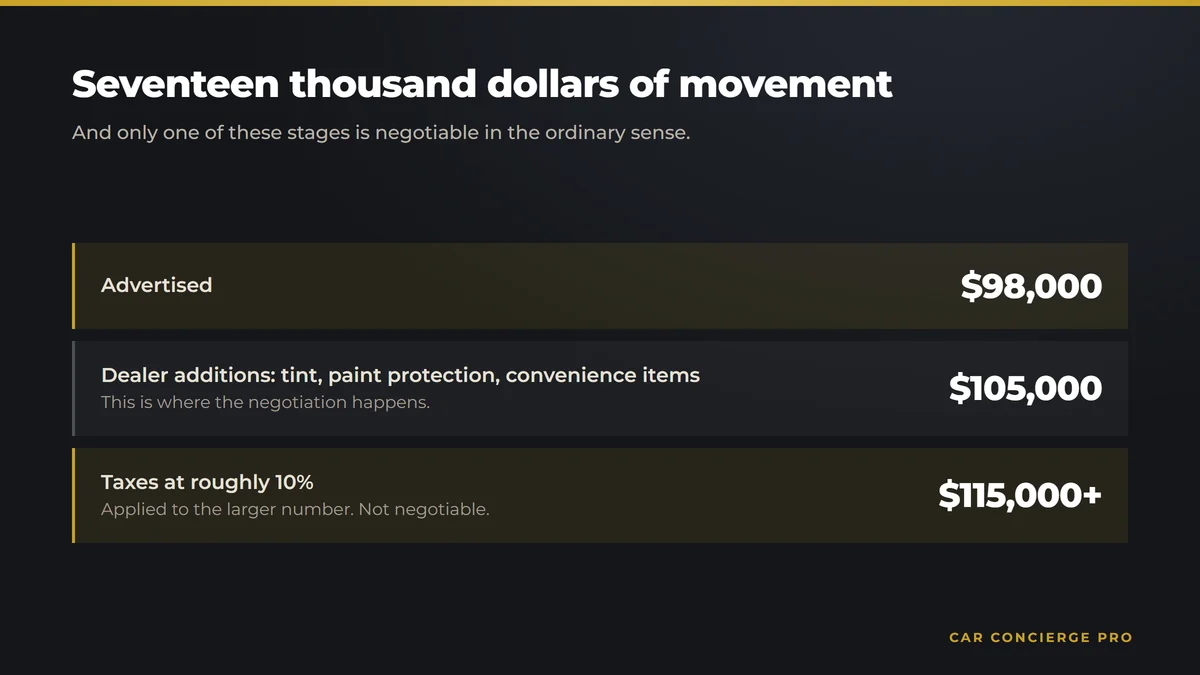
The arithmetic laid out on the call, for a car advertised around $98,000:
| Stage | Where it lands |
|---|---|
| Advertised price | $98,000 |
| Dealer additions: window tint, paint protection, convenience items | $105,000 to $106,000 |
| Taxes at roughly 10% | $115,000 and beyond |
Seventeen thousand dollars of movement, and only one of those stages is negotiable in the ordinary sense. The additions are, and the tax is not, which is why the additions are where the work goes.
So the price gets taken from the dealership in writing, with the add-ons removed, leaving the negotiated vehicle price plus only the applicable taxes and fees. Nothing on top. The CCP Out-The-Door Price Calculator does that conversion on any candidate.
Should You Import From the US?
Only if the gap survives the paperwork and two legs of shipping, and that is a calculation rather than an assumption.
The US market has far more of these cars, and they are often cheaper. The temptation is to read a $10,000 difference as a $10,000 saving. The comparison that actually decides it:
- The price difference, in real terms after exchange
- The cost and time of the import protocol and its paperwork
- Transport from the selling dealership to the border region
- Transport onward to Ottawa
- Any inspection or compliance work required on arrival
Set that total against the alternative: paying perhaps $5,000 more for a Canadian car and avoiding all of it. Sometimes importing wins comfortably. Sometimes a $10,000 sticker gap closes to nothing, and the domestic car is the better buy once your own time is counted.
Geography matters inside Canada too. A car in Alberta or Edmonton still needs transporting to Ottawa, and that cost belongs in the comparison exactly as an American one does.
Import requirements change, so confirm the current rules and admissibility for the specific vehicle before committing to a cross-border purchase.
The Window Sticker Settles the Options Question
On a car whose value is mostly its options, the build document is the only reliable record of what it has.
This is where sourcing from the US has an advantage beyond price. The dealership or seller is asked for the build document or window sticker, which lists every package the car left the factory with and the original MSRP those packages added up to.
That does two jobs at once. It confirms the car genuinely has the rear entertainment, the executive package and the headliner, rather than a listing saying "fully loaded". And it gives the original price of this exact configuration, which is the input the next step needs.
Without it you are trusting an advert about a feature list worth tens of thousands of dollars.
Depreciation Analysis: What Should It Cost Today?
Take the original MSRP of that specific build, apply the depreciation the model has actually seen, and you have a defensible number.
This is the method rather than a guess at a discount. A 2023 car with a known original MSRP, two years of market depreciation on this generation, and its kilometers, produces an expected value for today. Compare the asking price against it, and you know whether $98,000 is strong, fair or absurd, with a figure rather than an instinct.
Then every candidate is plotted, kilometers against price, so the set can be read at a glance: the cars below the trend are the ones worth pursuing, and the ones well above it are the ones holding the market up.
The Fourth Approach: Advertise That You Are Buying
He asked a sharp question. Beyond negotiating with dealerships, is there a way to reach private owners who might sell but have not listed?
There is, and it inverts the usual search. Rather than hunting listings, the team posts that it is looking to acquire this specification, and lets sellers come inbound. People who would consider selling a loaded 7 Series but have not got around to advertising it are exactly the owners a listing search never finds.
Those inbound leads then get filtered hard, because private listings cut both ways: ownership verified, title confirmed, condition inspected, and funds moved safely. The volume is noise until it is filtered, which is most of the work.
That makes four routes in parallel: franchise dealerships, independent dealers, inbound private sellers, and the private listing platforms, with the US market available on top if the arithmetic favors it.
What Does the Engagement Cost?
A flat fee, split in two, with the second half payable only on delivery.
The reason given for splitting it is specific and worth repeating: taking the whole fee up front and hoping it works out is not accountability. Half the fee is earned by the search and the negotiation; the other half is earned by the car arriving.
Current pricing across all service tiers is published at CCP pricing.
The Car Concierge Pro Difference
- No commissions, no dealer affiliations, and no payments from any dealership
- A flat fee, half of it payable only on delivery
- Searches across both the Canadian and US markets, with the import math done honestly
- Build document or window sticker obtained per vehicle, so options are verified not assumed
- Depreciation analysis against the original MSRP of that exact configuration
- Internal pricing analytics used to say whether a market is overpriced
- Kilometers plotted against price so the set can be read at a glance
- Inbound sourcing: advertising to buy, not only searching listings
- Private sellers vetted for ownership, title, condition and payment safety
- Dealer add-ons stripped, with the price taken in writing before any visit
- Transport costed into the comparison, inside the country or across the border
Every engagement is backed by CCP's 30-day money-back guarantee. Terms and conditions apply.
Real CCP Client Savings
A snapshot of documented results across recent client engagements.
| Vehicle | Client Savings |
|---|---|
| Lexus GX 550 | $3,800 |
| Lexus NX 350h | $4,500 |
| BMW X3 | $7,592 |
| Audi S5 Coupe Premium Plus | $8,070 |
| Mercedes-Benz S500 4MATIC | $22,334 |
| Porsche Panamera 4S | $52,337 |
| Bentley Bentayga EWB | $60,174 |
| Rolls-Royce Ghost | $111,368 |
Every result above was negotiated independently on behalf of a real client. Names and identifying details are withheld for privacy.
Sound Like You?
Common situations that sound like this one:
- The car you want barely exists in your country
- You have found your ideal example and think the price is indefensible
- You want a fully optioned car and cannot verify the options from a listing
- You are weighing importing from another country against paying more at home
- You suspect your local market is simply overpriced for this model
- You would buy privately if you could reach owners who have not listed
- You want a number for what the car should cost, not an opinion
Every CCP engagement is backed by a 30-day money-back guarantee (terms apply).
FREQUENTLY ASKED QUESTIONS
1. How do you buy a car that barely exists in your market?
Count what exists, widen to the other country if the arithmetic supports it, and source inbound from private owners who have not advertised. On a pool of nine, walking away is not a strategy by itself.
2. Is it worth importing a car from the US to Canada?
Only if the price gap survives the import paperwork, compliance work and two legs of transport. A $10,000 sticker difference can close to nothing once all of it is counted, so compare totals and confirm current import rules first.
3. How do you verify a used car's options?
Get the build document or window sticker. It lists every factory package and the original MSRP they added, which a listing saying "fully loaded" does not.
4. How do you know what a used luxury car should cost today?
Start from the original MSRP of that exact build, apply the depreciation the model has actually seen, and account for kilometers. That gives a defensible expected value to compare the asking price against.
5. Why does a $98,000 car end up over $115,000?
Dealer additions such as tint, paint protection and convenience items lift the price first, then tax applies to the larger number. The additions are negotiable; the tax on them is not.
6. Can you find cars from private owners who have not listed them?
Yes, by advertising that you are buying rather than only searching what is for sale. Those leads then need ownership, title, condition and payment all verified before anything proceeds.
7. Should kilometers or options matter more on a luxury car?
On a car whose value is largely its configuration, options and model year usually matter more than a modest difference in kilometers, which is why the specification should be fixed and the mileage flexible.
Start Your Own Engagement
The right vehicle at the right price, with every number documented before you sign.
Schedule a complimentary 30-minute consultation.
Read more client journeys at Client Stories, or see what clients say at Client Reviews.
📞 +1 (480) 418-6390
🌐 carconciergepro.com
Every CCP engagement is backed by a 30-day money-back guarantee (terms apply).