















In this article
The car maintenance tasks that are easy to ignore share one thing: nothing tells you about them. No warning light, no squeal, no shudder at highway speed. Your dashboard covers what the car monitors, which is a shorter list than most owners assume, and everything outside that list runs on a schedule only the owner’s manual knows about.
Seven of them come up constantly. A few cost you at the repair counter. The rest show up later, when someone appraises the car and starts subtracting.
The services that run on a calendar, not an odometer
Mileage-based maintenance takes care of itself. You hit 5,000 or 10,000 and something reminds you. Time-based maintenance has no such mechanism, which is why it gets skipped for years without anyone noticing.
Brake fluid
Brake fluid absorbs moisture out of the air, a little at a time, through the reservoir and the flex lines. Most manufacturers specify a flush every two or three years no matter how far you’ve driven. Very few owners have ever had it done.
Water in the fluid drops its boiling point. On a long descent or during hard stops, that produces a pedal that goes soft, which is unnerving the first time it happens and dangerous the second. Over a longer stretch, moisture corrodes calipers and the ABS module from the inside, and an ABS module is not a cheap part.
A flush usually runs somewhere in the range of a hundred to a hundred and fifty dollars. Pull your manual and check the interval. If you can’t remember the last time it was done, it hasn’t been.
The cabin air filter
Fifteen to forty dollars, ten minutes, often behind the glovebox. Owners routinely go five or six years without touching it.
A clogged filter kills airflow, so the defroster takes longer to clear the windshield in winter. Then it starts to smell, because at that point it’s a damp mat of paper and organic debris sitting in your ventilation system.
The smell is what costs you. When a used car manager can’t identify why an interior smells, they don’t investigate. They assume the worst case, because assuming otherwise is how they lose money. I’ve had cars come to me for full ozone treatment and upholstery extraction when the entire problem was a filter that should have been replaced in 2021.
Water and dirt in places you can't see
If your car has a sunroof, it has drain tubes running down the A pillars and out near the rocker panels. They’re small, they’re open at the top, and they fill with pollen, pine needles, and dust. Nobody thinks about them because nobody knows they exist.
When they block, water backs up into the headliner and runs down inside the pillar, usually landing in a footwell or on whatever electronics live under the front seats. Owners find it as a damp carpet with no obvious source, weeks after mold has started, and by then the repair involves pulling trim and possibly a module.
Clearing them is a five minute job with compressed air and a bit of care. Same story with the cowl drains under the base of the windshield, which is where leaves collect if you park under trees.
What quietly ruins a set of tires
Tires are one of the largest single reconditioning items on any appraisal sheet, which makes the two things that shorten their life worth more attention than they get.
Alignment
Most people treat alignment as a repair rather than a service. You hit a pothole hard enough to rattle your teeth, so you get it checked. Otherwise it’s not on the calendar at all.
But alignment drifts gradually, and the first evidence is uneven wear along the inner shoulder of the front tires, on the side you never look at. By the time it’s visible from where you normally stand, you’ve already bought a set of tires early. Getting it checked once a year, or any time the steering wheel sits slightly off-center on a straight road, is the whole fix.
Tire age
Rubber hardens on a calendar whether or not you drive on it. A tire with two thirds of its tread left can be seven years old and noticeably worse in the wet than the tread depth suggests.
The manufacture date is stamped on the sidewall in a four digit DOT code: week, then year. A tire marked 0623 was made in the sixth week of 2023. It takes ten seconds and almost nobody has ever looked. Low mileage cars, weekend cars, and second vehicles are where this hides.
Paint and interior wear counts as maintenance
Most owners file this under appearance. It belongs under maintenance, because clear coat is a protective layer with a finite service life and interior materials degrade rather than just fade.
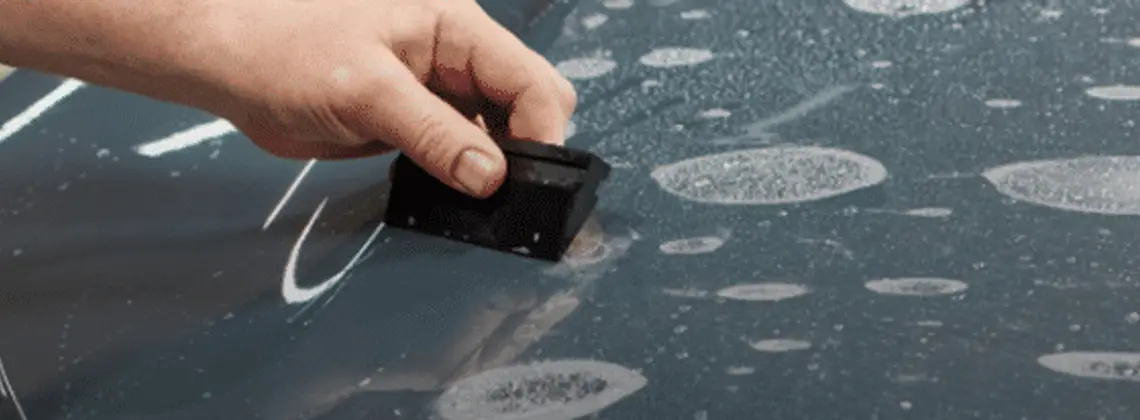
Bird droppings, tree sap, brake dust, and industrial fallout are all acidic or ferrous. Left on paint through a hot afternoon, they etch into the clear coat instead of sitting on it. Once the etching is below the surface, no amount of washing brings it back, and you’re into polishing, which removes clear coat rather than adding it. There’s a limited number of times any panel can go through that.
Climate decides the pace. In the Southwest, UV load is relentless and the tap water is mineral heavy, so a driveway wash in direct sun bakes spots into glass and paint the same afternoon. In Las Vegas that’s the normal condition of a car rather than an unusual one, and mobile car detailing crews handle decontamination and a single stage polish in a driveway or an office lot in a few hours. Interiors need the same treatment on a slower clock: UV protectant on the dash, and spills dealt with before they set rather than after.
Timing is the whole argument. Correcting damage while it’s in the clear coat is affordable. Correcting it after it’s through the clear coat means paint.
The one that's free
Keep the receipts.
Service records aren’t maintenance for the car, they’re maintenance for what the car is worth. Every item above is invisible to a buyer or an appraiser, which means they have to guess, and a guess always breaks against you. A folder of dated invoices converts a list of unknowns into verified history, and used vehicle values are built almost entirely on how much of the history can be verified.
It costs nothing. It’s still the item people skip most.
Frequently Asked Questions
How often should brake fluid actually be changed?
Check the manual first, since intervals vary by manufacturer, but two to three years is the common specification. It’s time-based, not mileage-based.
Does a detail before selling actually change the offer?
It changes the reconditioning estimate, which is what the appraiser subtracts. “Nobody’s paying you extra for a clean car,” says Carlos T., a detailer who takes pre-sale bookings through Panda Hub, a car detailing service that connects car owners with local detailers. “They’re just not deducting for a dirty one. That’s the part people get backwards.”
What’s the single most overlooked item on this list?
Sunroof drains, by a distance. Most owners don’t know the tubes exist until there’s water in the carpet.