
In this article
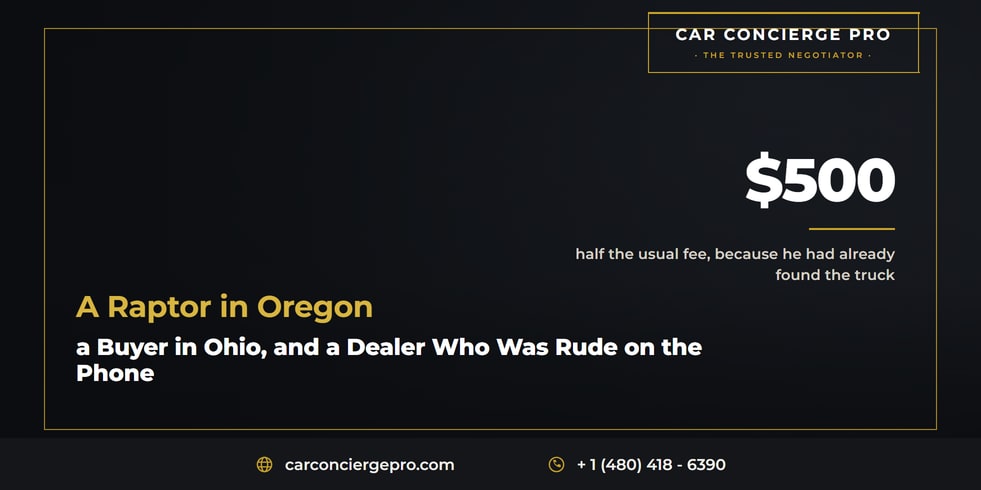
He had already done the hard part. A 2014 Ford F-150 Raptor, the exact truck he wanted, sitting on a lot in Oregon while he was in Ohio. He had called the dealership a couple of times, and they had been rude to him on the phone.
So he stopped. Not out of pride, but out of calculation: he did not want to lock himself into a number higher than he was willing to pay, and he did not want to spend four days driving a truck back across the country. "I figure this might be the best use of my time and money." This is the discovery call that took it from there, and it ended with a fee half the usual size.
When the Dealer Is Rude, Stop Talking
Walking away from a conversation is not the same as walking away from the truck.
His instinct was right and it is worth naming, because most buyers do the opposite. Faced with an unpleasant salesperson, they keep going, partly from momentum and partly because the car is the thing they want. What they are actually doing is negotiating while annoyed, against someone who is not, and anchoring themselves to a price in the process.
He recognized that and paused before he said a number. That left the negotiation entirely unanchored, which is the single most useful thing a buyer can hand to whoever negotiates next.
Dealership behavior is also simply absorbable by someone doing this all day. Rudeness, non-response, the three-day silence: those are conditions of the job rather than obstacles, and the person on the receiving end does not have to be the person who wants the truck.
Explore the full Car Buying Concierge service to see how a complete engagement is structured from the first call onward.
Behind Every Great Deal Is One Team. Meet Car Concierge Pro
Neel Mehta, founder and chief negotiator at CCP, is an Arizona State University alumnus in biomedical informatics and, by his own first words on this call, not a dealership person. He never planned to do this.
It started with his own purchase and how opaque the process turned out to be. People heard he had negotiated a good deal and began asking him to do theirs, often with the same reason attached: no bandwidth, or a parent who hates dealerships, and a wish for the whole thing to be handled.
Before the pandemic the business served Arizona and California only. It now works across the USA, Canada and the Middle East, has served more than 1,200 clients, negotiated over $6.78M in client savings, and holds 122 reviews at a 4.8 rating with BBB A+ accreditation. It takes no kickbacks, commissions or incentives from any dealership.
How Do You Inspect a Truck You Cannot Visit?
With four separate sources of evidence, none of which is the salesperson's description.
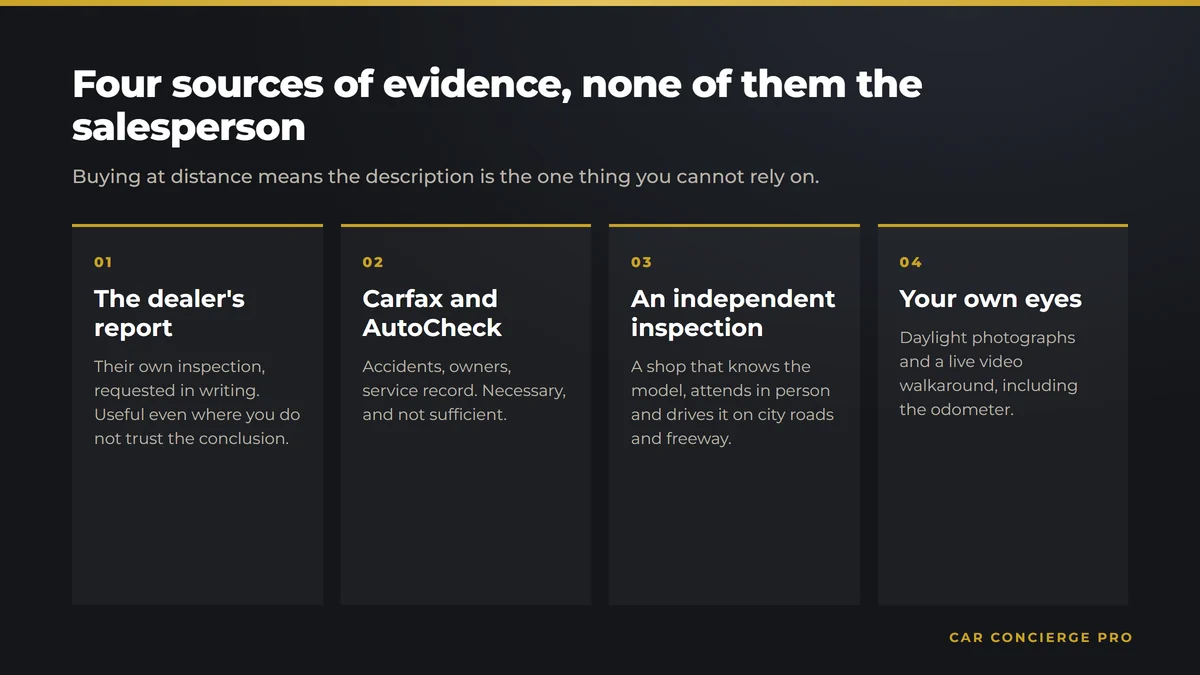
This was his first question, and it is the right first question for any remote purchase. The answer, in order:
- The dealership's own inspection report. Requested in writing. It shows what the dealership looked at, which is useful even when you do not take its conclusions on trust.
- Carfax and AutoCheck. Accident history, owner count, service record. Necessary, and not sufficient: neither report knows what the truck sounds like.
- An independent pre-purchase inspection. A third-party mechanic or shop with experience of that specific make and model, chosen with their Google reviews read, who physically attends the dealership. Not a phone call. They drive the truck on city roads and on the freeway and write it up.
- Your own eyes, remotely. Full photographs taken in daylight, never at dusk or under lot lights, plus a live video walkaround where you can ask them to point the camera at the dashboard and the odometer, so the mileage you have been told matches the mileage on the truck.
That fourth step costs nothing and catches a surprising amount. Evening photographs hide paint and panel work. An odometer on a video call cannot be rounded down in an email.
On a fifteen-year-old performance truck, step three is the one that decides the purchase. Findings on the engine or transmission end it. Findings on wear items become a priced argument with the dealership.
What a Clean Deal Looks Like
Listing price, plus only the applicable taxes and fees. Nothing else.
That sentence is the whole negotiating position, and everything the dealership wants to add to it is the negotiation. The list from this call: dealership fee, documentation fee, convenience fee, paint protection, window tint, security and etch fees. They come off, and what is left is quoted in writing before anyone travels.
Writing matters more at distance than locally. A dealership will happily say it will honor a phone price when you walk in, and the walk-in is where the additions reappear. For a buyer two thousand miles away, a price that only exists verbally is not a price at all.
The CCP Out-The-Door Price Calculator turns any quote into the total you would actually pay.
Is One Truck Enough to Negotiate On?
Only if you know what the alternatives cost, which is why a single-vehicle engagement still begins with a market scan.
He was locked onto this specific Raptor, and that is a legitimate brief. But a buyer with one option has no leverage, and the fix is not to pretend otherwise. It is to find out how many comparable trucks exist, with the same specification and window sticker, within 200, 500 and 1,000 miles, and at what prices.
That scan does two things. It tells you whether this truck is fairly priced or not, and it gives the negotiation something true to stand on. "There are three like it inside 500 miles and two are cheaper" is a position. "I really want this one" is not.
Then the conversation comes back to the truck he actually wants, with the market intelligence done.
The Fee Was Halved Because He Had Already Found the Car
$500 instead of $1,000, split $250 at the start and $250 after the truck arrived.
The reasoning given was straightforward: the usual fee covers market research, inventory sourcing and curation, and he had done that part himself. So the fee was reduced to the work that remained, which was negotiating with an uncooperative dealership, arranging and reviewing the inspection, and coordinating the shipping.
That is worth noting as a structural fact rather than a kindness. A flat fee that does not flex would have charged him for work nobody was going to do. Two payments, the second contingent on the truck being in his driveway at the negotiated price, with the inspection and shipping handled.
Everything else is paid directly to whoever provides it, never through CCP:
| Payment | Paid to |
|---|---|
| $250 + $250 concierge fee | CCP |
| The full price of the truck | the dealership, by wire |
| Pre-purchase inspection | the inspection company |
| Shipping | the carrier |
Current pricing across all service tiers is published at CCP pricing.
Getting It Home: Flatbed or Fly Out
Both work, and the choice is partly financial and partly about whether you want to see it first.
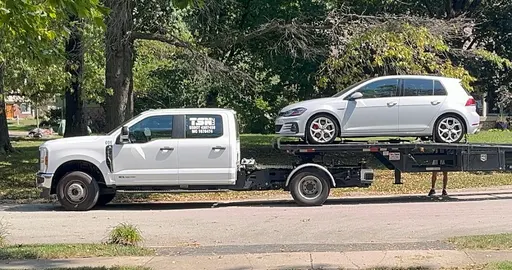
The default is a flatbed to the door. The alternative is to fly out, sign the paperwork in person, and drive it home, which he had already priced at about four days of his life and had sensibly declined. Travel can be arranged either way.
Inspection pricing varies by where the vehicle is, so the quotes come from the market around the car rather than from a rate card, and the options are presented with contact details, ratings, price, the type of inspection and who the point of contact is before any of them is engaged.
Financing: Your Bank or Theirs
Either, and if it is theirs, the rate is negotiated like the price.
He planned to line up his own funding and wire the dealership directly, which is the cleanest route. The alternative is dealership financing, in which case the APR becomes another line to negotiate, alongside the price, rather than something accepted at the end of a long day.
The point is that financing is not a separate transaction from the purchase. A good price at a bad rate is not a good deal, and the monthly payment is where both of them end up.
The Car Concierge Pro Difference
- No commissions, no dealer affiliations, and no payments from any manufacturer, inspector or carrier
- A flat fee, reduced when part of the work has already been done by the client
- Half the fee payable only once the vehicle is at your door
- Dealer add-ons stripped to listing price plus applicable taxes and fees
- Every price taken in writing before the client travels or wires anything
- The dealership's own inspection report requested and read
- Independent pre-purchase inspection by a shop that physically attends and test drives
- Daylight photographs and a live video walkaround, including the odometer
- Comparable inventory scanned at 200, 500 and 1,000 miles even on a single-car brief
- Shipping and inspection quoted and paid direct, never marked up
- Financing arranged through your bank or negotiated with the dealership on rate
Every engagement is backed by CCP's 30-day money-back guarantee. Terms and conditions apply.
Real CCP Client Savings
A snapshot of documented results across recent client engagements.
| Vehicle | Client Savings |
|---|---|
| Toyota Prius | $1,350 |
| Hyundai Tucson Hybrid | $3,500 |
| Lexus GX 550 | $3,800 |
| Lexus NX 350h | $4,500 |
| BMW X3 | $7,592 |
| Audi S5 Coupe Premium Plus | $8,070 |
Every result above was negotiated independently on behalf of a real client. Names and identifying details are withheld for privacy.
Sound Like You?
Common situations that sound like this one:
- You have found the exact vehicle and it is nowhere near you
- The dealership has been unpleasant and you stopped before naming a price
- You do not want to spend days driving a purchase home
- You want the truck inspected by someone who will actually attend and drive it
- You have been sent photographs taken after dark
- You already did the searching and do not want to pay for it twice
- You want the price in writing before you wire anything
Every CCP engagement is backed by a 30-day money-back guarantee (terms apply).
FREQUENTLY ASKED QUESTIONS
1. How do you buy a used truck in another state safely?
Get the dealership's inspection report, the Carfax and AutoCheck, an independent inspection by a shop that attends in person and drives the vehicle, and daylight photographs plus a live video walkaround including the odometer.
2. Should you keep negotiating with a rude dealership?
Not while you are annoyed, and not before you have an alternative. Pausing costs nothing and leaves you unanchored. The truck does not disappear because one phone call went badly.
3. What should a used vehicle quote include?
The listing price plus the applicable taxes, title, registration and documentation fee. Dealership fees, convenience fees, paint protection, window tint, security and etch charges are additions, and they are negotiable.
4. Why ask for photographs taken in daylight?
Because evening light and lot lighting hide paint repair, panel gaps and dents. A daylight set and a live video call are free, and they catch what a condition report describes generously.
5. Does a concierge still help if I have already found the car?
Yes, and the work is smaller, so the fee should be. Here it was halved to $500 because the market research had already been done by the buyer, leaving negotiation, inspection and shipping.
6. Is it cheaper to fly out and drive a car home?
Sometimes, but price the flight, the nights, the fuel and the days against a flatbed at roughly a dollar a mile. On a cross-country purchase the truck usually travels better than you do.
7. Should you use dealership financing or your own bank?
Either, as long as the rate is negotiated. Arrange your own as a benchmark, then let the dealership try to beat it. A good price at a poor rate is not a good purchase.
Start Your Own Engagement
The right vehicle at the right price, with every number documented before you sign.
Schedule a complimentary 30-minute consultation.
Read more client journeys at Client Stories, or see what clients say at Client Reviews.
📞 +1 (480) 418-6390
🌐 carconciergepro.com
Every CCP engagement is backed by a 30-day money-back guarantee (terms apply).