


In this article
Her car had been totaled, the insurance company had put a number in front of her, and she had already moved on to the next question: which car to replace it with. A 2026 Honda Civic hatchback, in New Mexico, and she had heard that Hondas leave no room to negotiate.
Both of those assumptions were worth testing, and the call started with the one she had not asked about. Before anything else, the insurance offer. On this engagement the money was not only in the purchase; it was also in the payout she had not yet accepted, and in the loan rate she had not yet been quoted. This is the call that laid out all three.
Never Accept the First Total-Loss Offer
An insurance settlement on a totaled car is an opening offer, not an assessment, and the insurer is obliged to pay you whatever you successfully argue for.
The example given on this call was from the month before. A client rang to ask whether he should accept the $43,000 his insurer had offered. A quick review of the car and its mileage put the realistic range at $48,000 to $51,000, so he was told to push for it. He opened at $55,000 against their $43,000. He settled at $49,500.
Same car, same accident, $6,500 more, and he put it straight into the down payment on the next vehicle.
The reason this works is worth understanding. Neel's position, stated plainly on the call, is that an appraiser's job is to get the policyholder to accept the lowest number they will accept, and that there is an incentive attached to the gap. Whether or not that is true of any particular insurer, the structural point holds: the first figure is the one that serves them, and asking for more carries no risk. They cannot withdraw the obligation to pay.
And the timing is against you. A total loss arrives with a frightened, inconvenienced, car-less person who is already thinking about the replacement. That is not the state in which anyone negotiates well.
Explore the full Car Buying Concierge service to see how a complete engagement is structured from the first call onward.
Behind Every Great Deal Is One Team. Meet Car Concierge Pro
Neel Mehta, founder and chief negotiator at CCP, is a TEDx speaker and a Biomedical Informatics graduate from Arizona State University, and he is explicit about what he is not: he did not come from a dealership, and this is not a business built because dealership margins looked attractive from the inside.
It began with his own first new car as a graduate student. He wanted one Nissan SUV, one configuration, and visited dealership after dealership across the Arizona valley. Every one quoted a different price for the identical vehicle. He took leave from work, negotiated it down by more than $5,000, and went back to his job. Then friends started asking him to come along to their own purchases.
CCP has since served more than 1,200 clients, with 122 reviews at a 4.8 rating, BBB A+ accreditation and recognition as the best automotive concierge service provider in 2025. It began in Arizona, expanded nationwide during the pandemic, then into Canada, and now the Middle East. It owns no inventory, brokers nothing, and takes no commission, referral or kickback from any dealership, so the fee the client pays is the whole of what it earns.
How Does a 6% APR Become 4%?
By treating the first rate as an opening position and climbing the authority ladder, one level at a time, over two days.
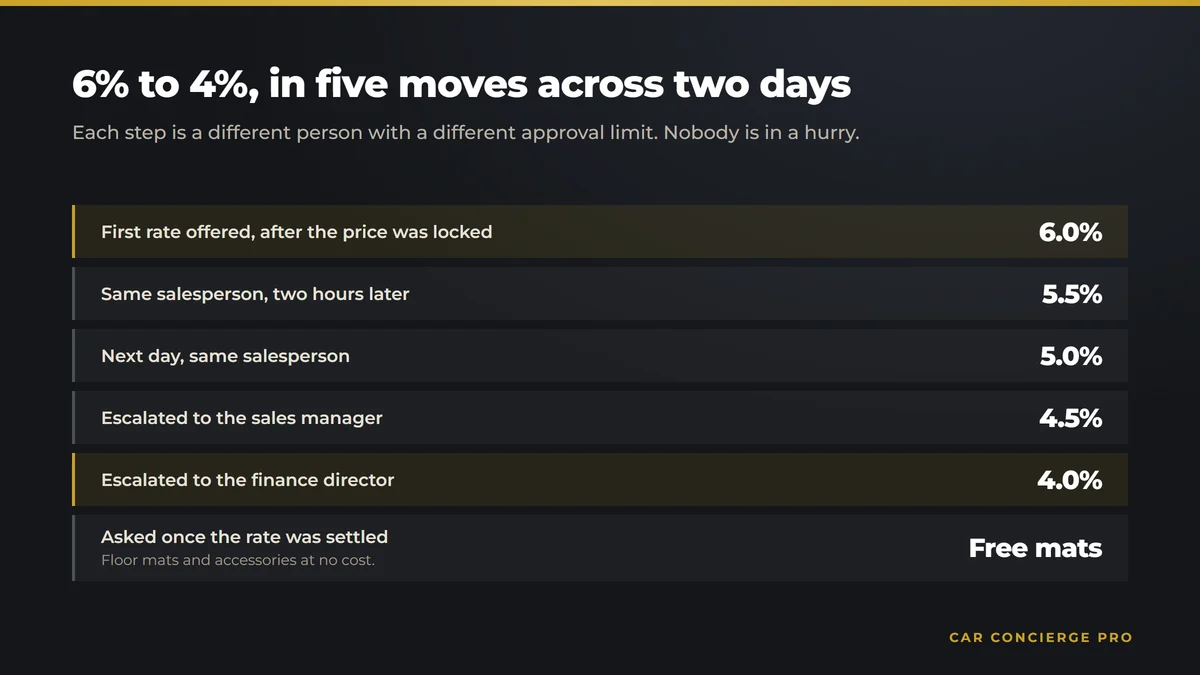
This is the part of the process most buyers never see, because by the time the rate is quoted they are tired and sitting in an office. The sequence described on this call, in order:
- The out-the-door price is locked first. Only then does the dealership run credit.
- The first rate comes back. Here, 6%. It is never accepted. The question is simply "that is too high, what else can you do?"
- Two or three hours later it returns at 5.5%, usually with "that is the best I can do, you have to take it today." The answer is that it is late, and tomorrow is fine.
- The next day it moves from 5.5% to 5%.
- Then: "thank you, could you take my application to your manager?" Manager level takes it from 5% to 4.5%.
- Then: "could you move me to the finance director?" Director level takes it from 4.5% to 4%.
- Finally, with the rate settled: "we are your customer now, what else can you include?" That tends to produce floor mats and accessories at no cost.
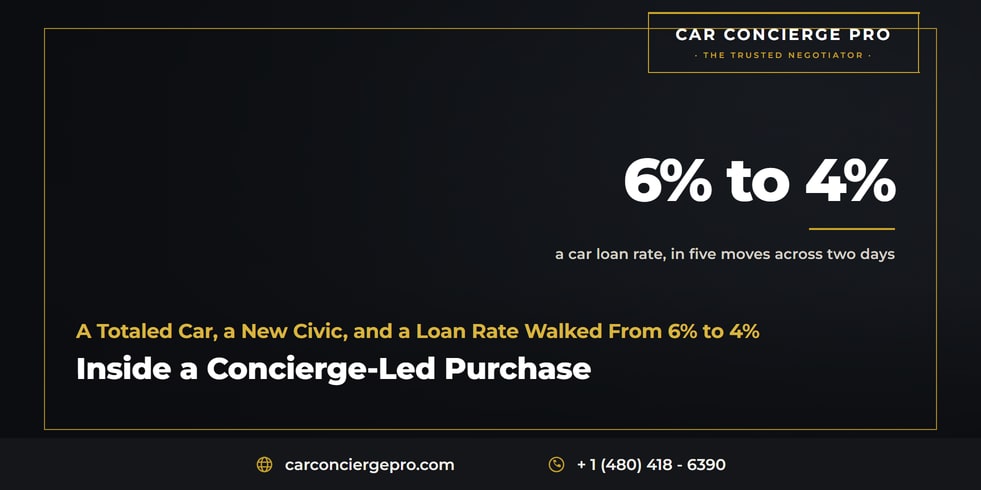
Six percent to four percent, in five moves and two days. Nothing in that list is clever. What makes it work is that each step is a different person with a different approval limit, and that nobody is in a hurry.
Two percentage points is not a detail. On a five-year loan it is a four-figure sum on a car in this class, and it arrives after the price has been agreed, which is exactly when most buyers have stopped negotiating.
Why the Rate Is Negotiated After the Price, and Not With It
Because a monthly payment can be built from any combination of price, rate and term, and only one of those is the car.
Locking the out-the-door price first means the vehicle has a settled, written number before financing enters the conversation. After that, a better rate is a straight improvement rather than something that can be funded by quietly raising the price, extending the term, or adding a product.
It is also why the number that gets negotiated is the out-the-door total, including taxes, title, licensing and registration, rather than the monthly payment. A payment is an output. The CCP Out-The-Door Price Calculator works on the input.
Do Hondas and Toyotas Really Leave No Room?
No. The reputation is real, the conclusion drawn from it is not.
Her point was reasonable: Hondas and Toyotas hold their value, which is a good reason to buy one, and the trade-off is supposed to be that they do not discount. The answer on the call was direct. There has never been an engagement where the dealership's asking price was simply accepted. Roughly one client in fifteen is buying a Honda or a Toyota, so this is well-trodden ground.
What changes the number on a car that sells itself is not pressure, it is comparison. Every franchise dealership in range is listed with its stock number, trim, inventory status and window sticker, the applicable state taxes, licensing and registration are added, and then each is asked to improve on the others. Strong resale value does not stop dealerships competing with each other.
When Is It Worth Buying Out of State?
When the saving is larger than the cost of getting the car home, which means shipping belongs in the comparison rather than after it.
The working figure is about a dollar a mile. So a car eight hours away is not automatically cheaper because its price is lower, and it is not automatically worse because it is far. If a local dealership is at $45,000 and a distant one is at $46,000 including taxes, the distant one loses once shipping is counted. If the gap runs the other way, it wins.
Every candidate is therefore compared on landed cost: negotiated out-the-door price plus shipping. You make the shipping payment directly to the carrier and the car payment directly to the dealership. CCP takes nothing but its own fee, from either.
What Happens Before the Price Is Even Discussed
A test drive, arranged locally, with the price deliberately ignored.
This inverts the usual order and it is intentional. A test drive is set up at a nearby dealership whatever that dealership is charging, because the purpose is not to buy there. The purpose is to confirm the make, model, trim and ideally the color are right, with a run through town and on the freeway.
Only once the car itself is confirmed does the shortlist get priced, narrowed by elimination, and taken to negotiation on the top three or four. Shopping a price for a car you have not sat in is how people end up with the wrong car at a good price.
On her brief there were still choices inside the model: the 2026 Civic sedan, the hatchback, and hybrid versions of both, with the hatchback starting around $27,000. Those get driven and compared before anyone is asked for a quote.
What Does the Engagement Cost?
$998, split into two payments of $499, with the second one invoiced only after the keys are in your hand.
The first $499 starts the market research and the curation of options. The second is raised when the car is actually hers and she is satisfied with how it went. The fee is flat, agreed in writing, and does not move with the price of the car or the size of the saving.
Everything else is paid directly to whoever provides it: the dealership for the car, the carrier for shipping. Current pricing across all service tiers is published at CCP pricing.
The Car Concierge Pro Difference
- No commissions, no dealer affiliations, and no payments from any manufacturer
- A flat $998 fee, half of it payable only after delivery
- Guidance on negotiating a total-loss insurance offer before the next purchase begins
- Out-the-door price locked in writing before credit is ever run
- Loan rate negotiated separately, up through manager and finance director
- Search across 18+ listing platforms plus every franchise dealership in range
- Window sticker and stock number recorded for every candidate
- Test drives arranged before price enters the conversation
- Landed cost compared across distance, shipping included at about $1 per mile
- Dealership and carrier paid directly, never through CCP
Every engagement is backed by CCP's 30-day money-back guarantee. Terms and conditions apply.
Real CCP Client Savings
A snapshot of documented results across recent client engagements.
| Vehicle | Client Savings |
|---|---|
| Toyota Prius | $1,350 |
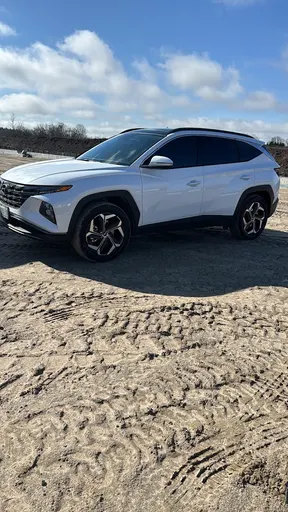
| Hyundai Tucson Hybrid | $3,500 |
| Lexus GX 550 | $3,800 |
| Lexus NX 350h | $4,500 |
| BMW X3 | $7,592 |
| Audi S5 Coupe Premium Plus | $8,070 |
Every result above was negotiated independently on behalf of a real client. Names and identifying details are withheld for privacy.
Sound Like You?
Common situations that sound like this one:
- Your car has been totaled and you have an offer you are not sure about
- You are replacing a car under time pressure you did not choose
- You have been told your preferred brand does not discount
- You expect to finance and do not know what rate you should be getting
- You want the price settled before anyone runs your credit
- You are willing to buy out of state if the math actually works
- You want to drive the car before you start arguing about its price
Every CCP engagement is backed by a 30-day money-back guarantee (terms apply).
FREQUENTLY ASKED QUESTIONS
1. Can you negotiate an insurance total-loss offer?
Yes. The first offer is a starting position, and asking for more carries no risk because the insurer's obligation to pay does not disappear. Support your counter with mileage, condition and comparable local listings.
2. How much can a car loan APR be negotiated?
Two percentage points is achievable, and this engagement describes 6% to 4%. The gains come from refusing the first rate and escalating through the salesperson, the manager and the finance director rather than from any single argument.
3. Should you negotiate the price or the financing first?
The price, always, and get it in writing before credit is run. Once the out-the-door number is fixed, a better rate cannot be funded by moving the price, the term or an added product.
4. Do Honda and Toyota dealers negotiate?
They do. Strong resale value is a reason to buy the car, not a reason the dealership will not compete. What moves the price is multiple dealerships quoting against each other on the same specification.
5. Is it cheaper to buy a car out of state?
Sometimes, once shipping is included at roughly a dollar per mile. Compare landed cost, not listing price: a lower price eight hours away can easily end up more expensive than a local one.
6. Should you test drive before or after negotiating?
Before. Confirm the car is right at any nearby dealership, regardless of its price, then price the shortlist. Negotiating hard on a car you have not driven is how buyers end up with a good deal on the wrong vehicle.
7. What should an out-the-door price include?
Vehicle price plus sales tax, title, licensing, registration and the dealer documentation fee, with shipping added if the car is sourced elsewhere. Anything quoted without a tax line is not an out-the-door price.
Start Your Own Engagement
The right vehicle at the right price, with every number documented before you sign.
Schedule a complimentary 30-minute consultation.
Read more client journeys at Client Stories, or see what clients say at Client Reviews.
📞 +1 (480) 418-6390
🌐 carconciergepro.com
Every CCP engagement is backed by a 30-day money-back guarantee (terms apply).