




In this article
He arrived with a document. Sixty-two years old, finishing a career overseas, moving to Denver in December, and planning for this car to be his for the next ten years. He had specified it himself: a used Acura Integra Type S, low miles, $50,000 out the door, and a list of must-haves and must-not-haves long enough that he apologized for it.
Then he named the real problem. "I'm a little reluctant dropping fifty grand and relying on a mechanic from a distance." He wanted his own mechanic in Denver to look at the car before he paid. On a used enthusiast car, bought from two thousand miles away, that is the right instinct and it is also the hardest thing to arrange. This is the discovery call that worked out how, and along the way it catalogued the games a buyer at that distance has to know about.
When You Cannot Stand Next to the Car You Are Buying
The distance is not the problem. The sequence is.
His reasoning for buying used was sound and deliberate. New is the easy route, and he said so: nobody has tracked it, modded it, or treated it badly. But he did not want to pay that much. A 2024 with low miles captures a chunk of depreciation and puts it in his pocket instead of the first owner's.
The catch is that the Integra Type S is an enthusiast car, and enthusiast cars get driven hard. So the saving he wanted and the risk he was taking were the same decision. He was not trying to eliminate that risk, which is not possible. He was trying to mitigate it, which is, and that is exactly what a documented inspection process is for.
"I'm looking for the right car, not a car." That line is the brief. Anybody can find an Integra on a listing site. Finding one that has been looked after, and proving it before the money moves, is the job.
Explore the full Car Buying Concierge service to see how a complete engagement is structured from the first call onward.
Behind Every Great Deal Is One Team. Meet Car Concierge Pro
Neel Mehta, founder and chief negotiator at CCP, is a TEDx speaker and a Biomedical Informatics graduate from Arizona State University.
CCP started with his own first new car: one Nissan SUV, one trim, one color, and twelve dealerships in the Phoenix valley, every one quoting a different price for the same vehicle. He negotiated it down by about $5,000 by making them compete and refusing any price not put in writing on a dealership quotation.
The firm has since served more than 1,200 clients across the USA, Canada and now the Middle East, on vehicles from $20,000 to $2 million, and negotiated close to $7 million in client savings. It holds 122 reviews at a 4.8 rating, BBB A+ accreditation and two 2025 Corporate Vision Awards. The team is 14 full-time people working six days a week, taking 15 to 25 engagements a month, with a founder-led huddle every morning.
What it does not do is take money from the other side. On this call Neel described the standing offer plainly: a dealership director will ring and suggest getting the client to pay two thousand more, with a thousand wired back, split between them. The answer is no, every time, and it is the reason the advice can ever be "walk away from this one".
Can You Make the Purchase Contingent on Your Own Mechanic?
Not in the way most buyers imagine. Dealerships will not ship a car to your town and wait for your mechanic's verdict, because payment comes before dispatch.
This was the first thing to settle, and the honest answer was no. His preferred structure, get the car to Denver, have his own man check it, then complete, is not a structure a dealership offers. The same is true of a private seller.
So the inspection has to happen where the car is, before the money moves. His options were to fly his mechanic to the car, which would take that mechanic out of his own shop for a day, or to hire an inspector near the car. The second is what usually happens, and it is only as good as the inspector.
One rule sits above all of this: if a dealership refuses to allow an inspection, the deal is dead. That refusal is information, and it is cheap to act on.
How Do You Hire a Mechanic You Have Never Met?
By turning the buyer's own specification into a brief, shortlisting inspectors against it, and letting the buyer's trusted mechanic judge their work before anyone is engaged.
The method on this engagement had four steps, and the third is the one most people never think of:
- His own specification document is rewritten as an inspection brief, aimed at a mechanic rather than at a dealer
- Inspectors near the candidate car are shortlisted, checked for Google reviews and for experience with that specific make and model
- Each is asked for a sample report from a previous job, with personal details redacted, so the depth of their work is visible before they are hired
- His own Denver mechanic reviews those samples and says whether the report would tell him what he needs
That third step turns an unverifiable hire into a verifiable one. You cannot assess a stranger's competence from a distance, but you can assess their output, and the person best placed to judge it is the mechanic you already trust.
Only after that does the inspection get commissioned. On this engagement the usual CCP step of recommending its own shortlist was adapted: his man in Denver would set the standard, and CCP's job was to find someone who met it.
Why the Deposit Comes Before the Inspection
Because the moment a dealership knows an inspection is coming, the car has a habit of being sold.
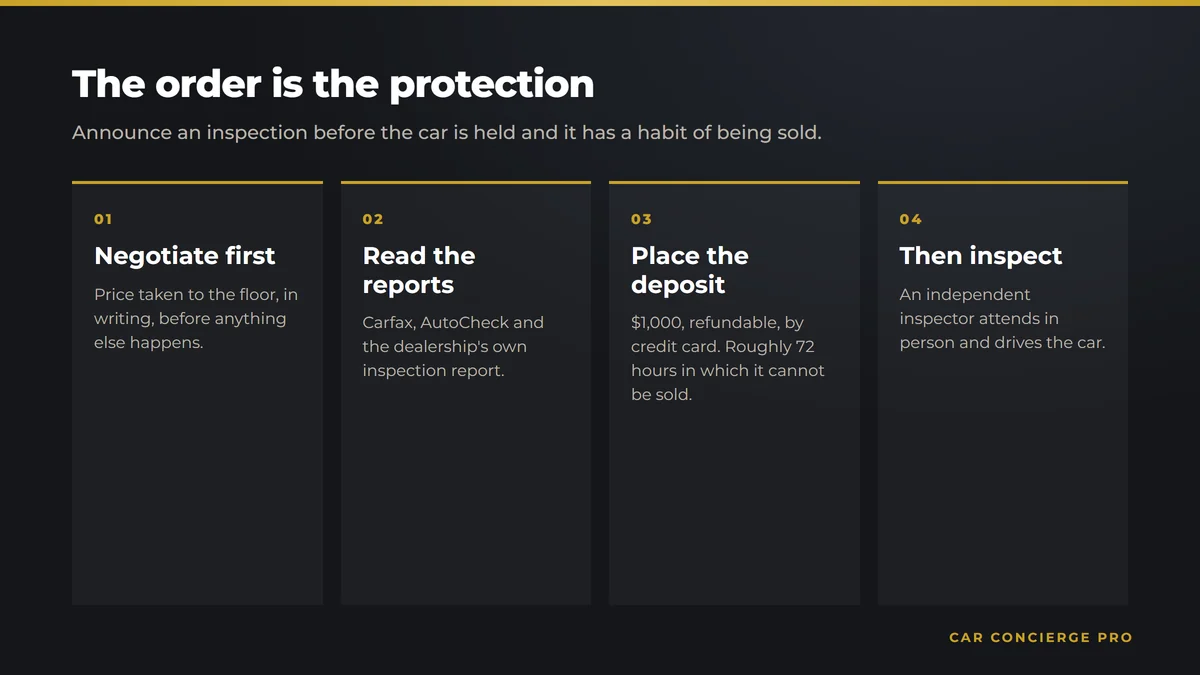
The sequence is deliberate. Price is negotiated to the floor first. Photos, videos, the Carfax, the AutoCheck and the dealership's own inspection report are all reviewed. Only when the buyer is ready to proceed does a $1,000 refundable deposit go down, and only then is the pre-purchase inspection ordered.
That deposit buys something specific: roughly 72 hours in which the car is legally yours to inspect. The dealership cannot sell it to someone else in that window, even to a buyer offering five thousand more. Without it, "we are sending an inspector tomorrow" and "the vehicle sold this morning" tend to arrive in that order.
Two safeguards go with it. The deposit is paid by credit card, so it can be disputed if a refund is withheld. And the dealership is told in writing that it is refundable, contingent on the findings.
What a Pre-Purchase Inspection Is Actually For
Two things: deciding whether to buy at all, and deciding what the car is now worth.
The first is a straight pass or fail. Findings on the engine or the transmission end the deal, because those are not negotiable repairs on a used performance car. Findings on wear items do not: a clutch, an air filter, an alignment, a set of tires.
The second use is the one buyers underuse. If the report lists $2,000 of work, that number goes back to the dealership as a choice: fix these before we complete, or take $2,000 off. An inspection is not just a safety check. It is a priced, evidenced argument, arriving after the price was supposedly final.
How far that can go came up as a cautionary tale from another engagement. A first-time sports-car buyer was looking at a $350,000 McLaren and was reluctant to spend $1,200 on an inspection for a car a dealership was vouching for. She was persuaded. The inspection found a five-figure list of upper-end work. The dealership's response was that it was selling as is, take it or leave it, so the deal was abandoned, with the deposit recovered. Finding her another example to the same specification took a further 24 working days and a second inspection at $1,500. That car was clean, and she has it.
The lesson is not that inspections find disasters. It is that the engagement could have closed that same day, fee earned, car delivered, and the buyer would have discovered that repair bill afterwards.
"Taxes Not Included" and the Other Games
A written total is not an out-the-door price unless the tax is a line on it.
This was the game the call kept returning to, and it is current. A salesperson gives you a figure in writing for the total cost of getting the car to you. It looks like the number you asked for. It has no tax line item, and the tax turns out to be payable when the car reaches your state. The buyer who felt protected by having it in writing was not.
Which is why every candidate on the tracking document carries its own column for exactly this: whether the quoted out-the-door figure includes tax, or whether the dealership is saying tax is due later. The PDF of the dealership's quotation is attached too, so a price cannot quietly rise by a thousand dollars overnight without someone being asked under what pretext.
Then there is the wire. A couple from Ohio wired $80,000 for a car in North Carolina to bank details the salesperson had sent them. The account was his own. He left the dealership and the country. The checks that prevent it:
- Details arrive from the dealership's official email address, never by text or messaging app
- The account name on the wire must be the dealership's, never an individual's
- A $1,000 wire goes first, and a dealership receipt for it is required before the balance follows
- Business is done with the internet sales manager, the finance manager or a director, not a front-line salesperson
None of that is exotic. It is just unfamiliar, and unfamiliar is where a $50,000 purchase gets expensive.
Does Certified Pre-Owned Justify the Premium?
Sometimes, and the premium is usually $2,500 to $3,000, so it is a real decision rather than a free upgrade.
Two facts frame it. Only the manufacturer's own franchise can certify its cars: an Integra can be certified by an Acura or Honda dealership and by nobody else, so a Type S on a Toyota or BMW lot is not CPO whatever the advert implies. And what you are buying with the premium is largely the extended warranty, since the inspection behind certification is one you are arranging independently anyway.
His own read was that he was not convinced it was worth it. The approach agreed was to search both, list them side by side, and let the price difference argue for itself.
He also ruled something out, and it was accepted: no aggregators. No Carvana, no CarMax. His worry was that a car reaching an aggregator may be one somebody wanted rid of. The practical objection from CCP's side was different and just as real: aggregators list vehicles they do not physically hold, and locating and moving one can take a month or two.
What Does It All Cost, and to Whom?
$1,000 to CCP, and three other payments that go to the people providing those services.
The concierge fee is $1,000, split in two: part at kickoff to start the research and curation, and the rest only once the car is in the garage. The fee is flat and not hourly, which Neel's own argument against billing by the hour sums up: an hourly rate gives the client no way to know what is going on.
The other three payments never pass through CCP, which takes no commission from inspectors or shipping companies:
| Payment | Roughly | Paid to |
|---|---|---|
| Concierge fee | $1,000, in two parts | CCP |
| Deposit, then the balance | the negotiated price | the dealership or private seller |
| Pre-purchase inspection | $150 to $200 on a car like this | the inspector |
| Shipping | about $1 per mile | the carrier |
Shipping is worth calculating rather than avoiding, because distance is a price lever. A car 200 miles away at $2,000 more is a worse buy than one 500 miles away at $500 more: the second costs about $500 to ship and still leaves $1,000 in hand. Landed cost is the only number that settles it, and the CCP Out-The-Door Price Calculator does that part.
Current pricing across all service tiers is published at CCP pricing.
How Long Does a Search Like This Take?
A typical engagement runs around 60 days, and the first week is calibration rather than shortlisting.
The first batch of options is not expected to be right. The team needs one or two rounds of feedback, usually four or five working days, before it is pinpointing cars rather than proposing them. Neel's own comparison was to training a model: you do not get the output you want on the first pass, you get it after correction.
The engagement does not expire when the brief changes either. One recent client switched mid-search from one model to an entirely different one, and the search restarted without a new fee and without being treated as a problem. On this engagement, with a December date and a buyer still abroad, no time limit was set at all.
The search began where it was most useful: Denver and the rest of Colorado first, so his mechanic could drive out in the morning and be home by evening, widening only if nothing right appeared.
The Car Concierge Pro Difference
- No commissions, no dealer affiliations, and no payments from any manufacturer, inspector or carrier
- A flat fee, part of it payable only after the car is in your garage
- Search across 18+ listing platforms plus direct dealership relationships
- Every candidate logged with its out-the-door price and whether tax is included
- The dealership's written quotation kept as a PDF against later changes
- Carfax, AutoCheck and the dealership's own inspection report on every shortlisted car
- A refundable $1,000 deposit by credit card to hold the car for inspection
- Independent pre-purchase inspection, with sample reports vetted before hiring
- Inspection findings used as priced leverage, or as grounds to walk away
- Wire-fraud checks: dealership-named account, official email, test payment first
- Dealt with managers and directors, not front-line salespeople
- Landed cost compared across distance, shipping included
Every engagement is backed by CCP's 30-day money-back guarantee. Terms and conditions apply.
Real CCP Client Savings
A snapshot of documented results across recent client engagements.
| Vehicle | Client Savings |
|---|---|
| Toyota Prius | $1,350 |
| Hyundai Tucson Hybrid | $3,500 |
| Lexus GX 550 | $3,800 |
| Lexus NX 350h | $4,500 |
| BMW X3 | $7,592 |
| Audi S5 Coupe Premium Plus | $8,070 |
Every result above was negotiated independently on behalf of a real client. Names and identifying details are withheld for privacy.
Sound Like You?
Common situations that sound like this one:
- You are buying from far away and cannot inspect the car yourself
- You want a used performance car and know it may have been driven hard
- You have a mechanic you trust and want their standard applied at a distance
- You want the car held while it is inspected, not sold out from under you
- You have a written total from a dealer and are not sure what is missing from it
- You are about to wire a large sum to someone you have never met
- You are weighing certified pre-owned against the premium it carries
Every CCP engagement is backed by a 30-day money-back guarantee (terms apply).
FREQUENTLY ASKED QUESTIONS
1. Can you buy a car contingent on your own mechanic inspecting it after delivery?
Generally no. Dealerships and private sellers both require payment before the car is dispatched, so the inspection has to happen where the car is, before the money moves.
2. How do you get a car inspected in another state?
Hire an inspector near the vehicle, after checking their reviews, their experience with that make and model, and a redacted sample report from previous work. A sample report is the only way to judge depth before you pay.
3. Why pay a deposit before a pre-purchase inspection?
A refundable deposit, usually around $1,000, gives you roughly 72 hours in which the dealership cannot sell the car to anyone else. Without it, announcing an inspection often precedes the car being "sold".
4. What happens if the inspection finds problems?
Engine or transmission findings should end the deal. Wear items become a negotiation: the dealership either fixes them before completion or discounts the car by the cost of the work.
5. What does "taxes not included" mean on a dealer quote?
It means the written total you were given is not the out-the-door price. Sales tax may be payable when the car reaches your state. Insist on an itemized quote with tax as its own line.
6. How do you avoid wire fraud when buying a car remotely?
Take bank details only from the dealership's official email, confirm the account name is the dealership's and not an individual's, send a small test payment first and get a receipt, and deal with a manager rather than a salesperson.
7. Is certified pre-owned worth the extra cost?
It depends what the premium buys. Typically $2,500 to $3,000, mostly for the extended warranty. Only the manufacturer's own franchise can certify its cars, and if you are arranging an independent inspection anyway, the inspection half of the value is already covered.
Start Your Own Engagement
The right vehicle at the right price, with every number documented before you sign.
Schedule a complimentary 30-minute consultation.
Read more client journeys at Client Stories, or see what clients say at Client Reviews.
📞 +1 (480) 418-6390
🌐 carconciergepro.com
Every CCP engagement is backed by a 30-day money-back guarantee (terms apply).