










In this article
Buying a car should be exciting. But for many people, the experience quickly turns into hours of researching dealerships, comparing confusing quotes, negotiating with salespeople, and trying to figure out whether the price on the table is actually a good deal.
You might find the vehicle you want, only to discover that the advertised price does not include thousands of dollars in dealer-installed accessories, protection packages, documentation fees, or other charges. If you are leasing, the dealer may focus on the monthly payment rather than the total cost of the agreement. If you have a trade-in, the dealership may offer an attractive price on the new vehicle while undervaluing your existing car.
This is where a professional car buying service can help.
At Car Concierge Pro, we approach car buying from the buyer's perspective. Instead of asking you to visit multiple dealerships and negotiate against experienced sales and finance teams on your own, we handle the research, compare competing offers, negotiate the complete deal, and help coordinate the process through delivery.
Since 2020, Car Concierge Pro has helped more than 1,200 clients across the United States, Canada, and the United Arab Emirates save over $6.78 million. Our experience has reinforced one important belief: buying a car is not simply about finding the right vehicle. It is about understanding the market, negotiating the right terms, and knowing exactly what you are paying for.
Here is how a professional car buying service actually works, what happens behind the scenes, and what buyers should understand before hiring one.
What Is a Car Buying Service?
A car buying service helps consumers find, evaluate, and negotiate the purchase or lease of a vehicle. Depending on the service, it may also help with trade-ins, financing comparisons, vehicle history research, inspections, paperwork reviews, and transportation.
Think of it as having a dedicated representative working on your behalf throughout the buying process.
At Car Concierge Pro, we work directly with dealerships to negotiate vehicle purchases and leases. We are not a dealership, and we do not sell cars ourselves. We represent the buyer's interests and help them make an informed decision.
Our role includes:
- Understanding your budget, vehicle preferences, and priorities.
- Researching market prices and available inventory.
- Identifying dealerships that can meet your requirements.
- Negotiating the vehicle price and challenging unnecessary charges.
- Reviewing financing or leasing terms and trade-in offers.
- Obtaining a written out-the-door price before you commit.
- Coordinating test drives, paperwork reviews, and vehicle delivery.
The important distinction is that a car buying service works for the buyer rather than relying on the dealership to guide the entire transaction.
Not every service operates the same way. Some provide access to prearranged discounts, while others offer research or referral services. At Car Concierge Pro, our approach centers on individualized research and competitive negotiation for each client's specific requirements.
How Does Car Concierge Pro Work Step by Step?
Step 1: We Start With a Free Discovery Call
Every client begins with a free 30-minute discovery call on Zoom or Google Meet with a dedicated specialist.
Before searching for vehicles, we need to understand what the client actually wants and what they can comfortably afford.
We discuss several important factors during this conversation:
- Total budget: What is the maximum amount the client wants to spend, including applicable taxes and fees?
- Buying or leasing: Does the client want to purchase the vehicle, finance it, or lease it?
- Vehicle condition: Are they interested in a new, certified pre-owned, or used vehicle?
- Features and preferences: Which safety features, technology, seating configurations, performance characteristics, and comfort options are essential?
- Deal-breakers: Which models, colors, features, or terms are unacceptable?
- Timeline: Does the client need a vehicle immediately, or do they have time to wait for the right opportunity?
- Trade-in: Do they have an existing vehicle they want to sell or trade?
- Financing: Do they already have a pre-approval from a bank or credit union?
One of the first things we clarify is the difference between a monthly payment and an actual budget.
A dealer might advertise a vehicle with an attractive monthly payment, but that payment could depend on a large down payment, a longer loan term, or other conditions. We want to understand the client's overall financial commitment rather than focus on one number.
Some clients arrive knowing the exact make, model, trim, color, and options they want. Others tell us something like, "I need a three-row SUV under $50,000."
Both situations work. Our job is to turn those preferences into a clear, practical search strategy.
Step 2: We Research the Market Before Contacting Dealerships
Once we understand the client's requirements, we begin researching the market.
We do not simply search for a vehicle online, identify a dealership advertising it, and accept the listed price as a starting point for the final deal.
Instead, we analyze the specific vehicle and the market surrounding it.
Our research considers:
- Current inventory and vehicle availability.
- Advertised prices and comparable vehicles.
- Regional pricing differences and nearby markets.
- Manufacturer incentives and applicable offers.
- Dealer-installed accessories and additional charges.
- Differences between comparable trims and equipment packages.
The objective is to establish a realistic understanding of what the vehicle should cost and which dealerships may be willing to offer competitive terms.
A vehicle advertised at MSRP is not necessarily a bad deal, and a vehicle advertised below MSRP is not automatically a good one. The actual value depends on the specific vehicle, market conditions, incentives, fees, and final transaction terms.
This research gives us a stronger starting point for negotiation.
Step 3: We Verify the Vehicle, Including Its VIN and History
When a client is considering a used or certified pre-owned vehicle, evaluating the individual car is just as important as negotiating its price.
Two vehicles of the same make, model, and year can have very different values depending on mileage, condition, accident history, title status, and maintenance records.
We review the specific vehicle identification number, or VIN, and examine the available history information before the client commits.
This process can include reviewing:
- Vehicle history reports.
- Title status and reported title issues.
- Accident and damage history, when reported.
- Available mileage and ownership records.
- Open safety recalls.
- Vehicle condition and other relevant documentation.
When appropriate, we can also help arrange a pre-purchase inspection.
A clean history report does not guarantee that a vehicle has never been damaged or that it is mechanically sound. That is why we encourage buyers to consider an independent inspection when purchasing a used vehicle.
The objective is to reduce avoidable risks while making sure the client understands what they are buying.
Step 4: We Approach Multiple Dealerships and Create Competition
This is one of the most important parts of our process.
After identifying suitable vehicles and dealerships, we take the client's requirements to our nationwide dealer network and request competitive offers.
Depending on the vehicle, location, inventory, and market conditions, we may contact five dealerships or as many as 17.
The dealerships understand that they are competing for the same transaction. Our goal is to create an environment in which each dealer has a reason to present its most competitive offer.
For example, during one vehicle search in Arizona, we received three quotes for the same car:
- Dealership A: $47,200
- Dealership B: $46,750
- Dealership C: $45,900
The lowest quote was $1,300 below the highest quote.
That is a meaningful difference for the same vehicle, before considering any other differences in taxes, fees, or transaction terms.
The example illustrates why it is valuable to compare multiple offers rather than assume that the first dealership has provided its best price.
However, we do not select a winning offer based on the lowest headline number alone. We also need to compare the vehicle specifications, included equipment, dealer charges, incentives, availability, and final out-the-door price.
A competitive quote is useful only when the terms are clear and comparable.
Step 5: We Negotiate the Complete Deal, Not Just the Sticker Price
Many buyers concentrate on negotiating the vehicle's advertised price. That is understandable, but the advertised price is only one part of the transaction.
A dealership may offer a discount on the vehicle while adding accessories, protection packages, or other charges. Financing and trade-in terms can also affect the overall financial outcome.
Our approach is to examine the complete deal.
Negotiating the Vehicle Price
We negotiate the selling price based on the vehicle's specifications, market research, available incentives, competing quotes, and the dealership's willingness to negotiate.
The objective is to obtain a competitive price supported by actual market information rather than an arbitrary discount from MSRP.
Challenging Dealer Add-Ons and Fees
We examine additional charges that can increase the total cost, including:
- Dealer-installed accessories.
- Paint, fabric, or other protection packages.
- Products presented as mandatory without a clear explanation.
- Documentation and preparation charges that warrant scrutiny.
- Other dealer-imposed fees or optional products.
Not every fee is improper or negotiable. Some charges are required by law, and documentation fees may be regulated or handled differently depending on the jurisdiction.
Our goal is to identify which charges are legitimate, which products are optional, and which costs can reasonably be challenged or negotiated.
Negotiating Lease Terms
Leasing requires a different approach from buying a vehicle outright.
A monthly payment can be influenced by the negotiated selling price, residual value, money factor, down payment, lease duration, mileage allowance, taxes, and fees.
We focus on the terms that determine the real cost of the lease, rather than allowing the entire discussion to revolve around a monthly payment.
A lower payment is not necessarily a better lease if it requires a larger upfront payment or comes with less favorable terms.
Reviewing Financing Options
If a client already has financing pre-approved through a bank or credit union, they can retain that arrangement.
Car Concierge Pro is not a lender. We do not take money from a client's lender for directing them to a particular financing product.
We help clients understand their available options and evaluate the financing terms as part of the overall transaction. The client remains responsible for selecting and entering into their financing agreement.
Negotiating the Trade-In Separately
A trade-in can make a car deal more complicated because the dealer is effectively evaluating two transactions: the vehicle being purchased and the vehicle being surrendered.
We work to evaluate the trade-in as a separate number so that an attractive offer on one vehicle does not distract from a weaker offer on the other.
For example, a dealership might offer a discount on a new vehicle but provide a lower trade-in valuation. Looking at the complete transaction helps reveal whether the overall deal is competitive.
Step 6: We Secure a Written Out-the-Door Price
Before the client commits, we want a clear written out-the-door price.
The out-the-door price represents the total amount payable for the vehicle transaction, including the applicable taxes, title and registration charges, dealer fees, and agreed-upon products or accessories.
For a financed or leased vehicle, the total financial commitment also requires reviewing the relevant financing or lease terms.
Consider an example from a transaction we negotiated:
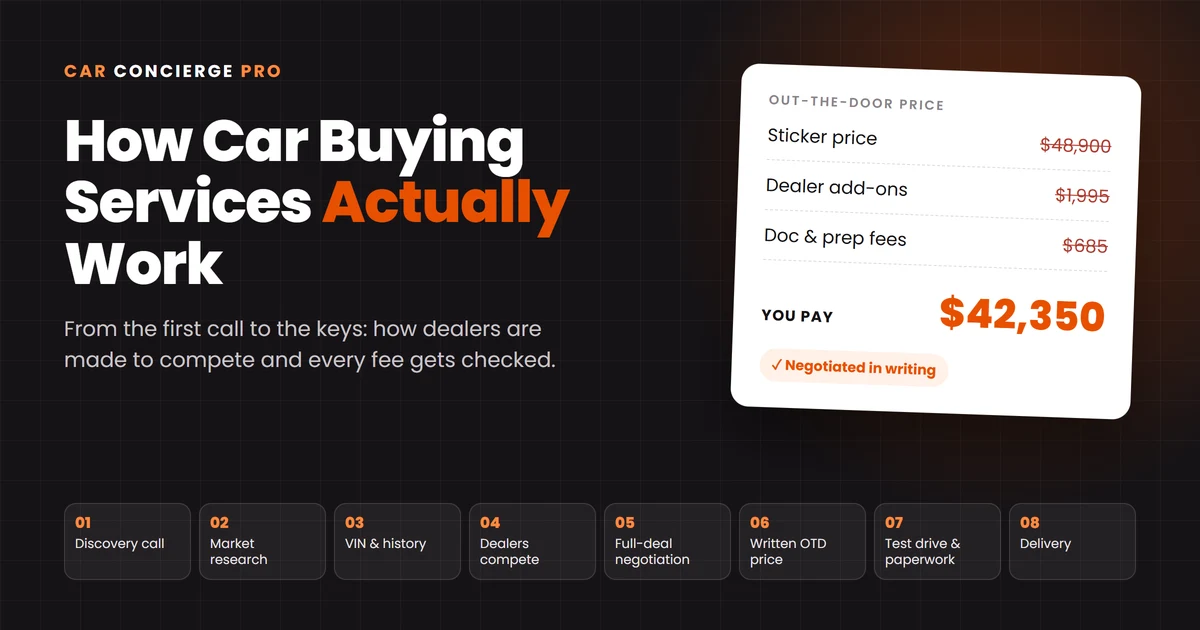
The vehicle had a sticker price of $48,900, along with $1,995 in add-ons and $685 in documentation and preparation fees. The deal ultimately closed at $42,350 out the door.
That represents a difference of $6,550 between the original sticker price and the final total.
It is important to understand that this comparison is not, by itself, a calculation of savings against the vehicle's market value. A proper savings calculation would also account for the original quote's complete terms, applicable incentives, taxes, and other relevant costs.
The bigger lesson is that buyers should evaluate the final amount they will pay, not just the advertised price.
A written quote also gives the client something concrete to review before visiting the dealership or signing the contract.
Step 7: We Coordinate the Test Drive and Review the Paperwork
Once we identify a suitable offer, we help coordinate the next steps.
If the client wants to drive the vehicle before purchasing it, we arrange the test drive with the selected dealership around the client's schedule.
Before signing, we review the paperwork with the client to help them understand the terms and identify discrepancies between the negotiated deal and the documents presented.
We pay particular attention to:
- The agreed-upon vehicle price.
- Taxes and registration charges.
- Dealer fees and add-ons.
- Financing or lease terms.
- Trade-in values.
- Optional products and warranties.
- Any changes from the written offer.
The final documents should reflect the deal the client agreed to.
The client signs the purchase, financing, and insurance documents directly with the relevant parties. Car Concierge Pro does not hold the vehicle, purchase funds, or title on the client's behalf.
Our role is to support the buyer and help maintain transparency throughout the transaction.
Step 8: We Help Coordinate Delivery
After the deal is finalized, the client can collect the vehicle from the dealership or arrange delivery to their home.
For eligible out-of-state transactions, we coordinate nationwide vehicle shipping through shipping partners.
This can be particularly useful for clients who find a better deal outside their immediate area. A vehicle that costs less in another state may still be a better overall option after accounting for transportation, taxes, registration, and other applicable expenses.
We encourage clients to evaluate those costs before making a final decision.
The objective is not simply to find the lowest-priced car anywhere in the country. It is to help the client obtain the right vehicle at a competitive total cost while making the process as straightforward as possible.
How Is a Car Buying Service Different From Buying a Car Yourself?
You can absolutely buy a car without professional assistance. Many buyers successfully research vehicles, compare offers, and negotiate their own deals.
The question is whether you want to manage the entire process yourself or have an experienced representative handle much of the work.
You Research the Market Versus Having Someone Research It for You
When buying independently, you may need to search multiple dealership websites, compare inventory, verify specifications, request quotes, and determine whether advertised discounts are realistic.
A professional car buying service handles much of that research and helps narrow the options to vehicles and dealerships that match your requirements.
You Negotiate One Dealer at a Time Versus Creating Competition
When you visit a dealership alone, the negotiation typically centers on that dealership's offer.
When multiple dealerships are competing for the same transaction, you have a clearer basis for comparing prices and negotiating better terms.
This does not guarantee that every concierge will secure a lower price than every individual buyer. A knowledgeable buyer may negotiate an excellent deal independently. The benefit of professional assistance is having a structured process, market research, and someone dedicated to managing the negotiations.
You Manage the Pressure Versus Having a Representative Handle It
Car buying can involve time pressure, repeated follow-ups, and requests to make immediate decisions.
A buyer may hear that a price is available only today or that another customer is interested in the same vehicle.
At Car Concierge Pro, we handle much of the dealer communication on the client's behalf. We can evaluate offers against the available alternatives rather than asking the client to make a decision in the middle of a high-pressure showroom conversation.
We still advise clients to make informed decisions based on their needs and the actual terms of the deal.
You Manage the Details Versus Having Support Throughout the Process
Buying independently means coordinating research, dealer appointments, trade-in discussions, paperwork, and possibly transportation.
With a car buying service, much of that coordination is handled for you, although the client remains responsible for reviewing and signing their own contracts.
For many clients, the convenience is valuable in its own right.
At Car Concierge Pro, we estimate that handling the process independently can take a buyer approximately 8 to 24 hours of research, calls, and dealership visits. Our process begins with one discovery call, with our team handling much of the work that follows.
Actual time savings vary depending on the vehicle, market, and complexity of the transaction.
How Much Does a Car Buying Service Cost?
The cost depends on the provider, the services included, and the complexity of the transaction.
Some services rely on dealer relationships, referral arrangements, memberships, or manufacturer programs. Others charge the buyer directly for research and negotiation.
At Car Concierge Pro, our published service structure is based on a flat fee:
- Buying or leasing: $998.
- Buying or leasing with a trade-in: $1,497.
- White Glove service: $2,495.
We are buyer-paid only. We do not accept payments from dealerships or manufacturers for directing clients to their vehicles.
This structure helps align our work with the client's interests. Our compensation does not depend on selling a particular car or steering the buyer toward a dealership that pays us a commission.
Before hiring any car buying service, I recommend asking exactly how the company gets paid, what the fee includes, whether there are additional charges, and whether it receives compensation from dealerships or other third parties.
A professional service should be able to explain its pricing and responsibilities clearly.
Is a Car Buying Service Worth It?
In my experience, the value comes down to three things: the quality of the negotiation, the time saved, and the confidence the buyer gains from understanding the transaction.
A car buying service may be particularly useful if you:
- Have limited time to research multiple dealerships.
- Want help comparing offers from different markets.
- Are negotiating a high-value vehicle purchase or lease.
- Need assistance evaluating a trade-in.
- Are considering a used or certified pre-owned vehicle.
- Feel uncomfortable negotiating with dealership sales and finance teams.
- Want someone to help review the deal before you sign.
- Are purchasing from an out-of-state dealership and need help coordinating delivery.
However, a service is not automatically worth the fee for every buyer.
If you enjoy researching vehicles, have time to negotiate, understand dealer pricing, and are comfortable comparing financing and trade-in offers, you may be able to manage the process yourself.
I encourage buyers to compare the service fee against the potential benefits without assuming that a particular amount of savings is guaranteed.
The right question is not simply, "How much money will I save?" It is also, "What work will this service take off my plate, what risks can it help me identify, and what will the entire transaction cost me?"
What Should You Look for When Choosing a Car Buying Service?
Not all car buying services offer the same level of support. Before hiring one, ask questions that reveal how the company actually operates.
Ask Who Pays the Service
Find out whether the service is paid exclusively by you or also receives compensation from dealerships, manufacturers, lenders, or other parties.
Compensation arrangements do not automatically determine the quality of a service, but transparency matters. You should understand whose interests the company is representing.
Ask Whether It Negotiates the Full Deal
A discount off MSRP may sound impressive, but it does not tell you whether the final transaction is competitive.
Look for a service that considers the out-the-door price, dealer add-ons, financing or lease terms, and trade-in valuation when applicable.
Ask How It Compares Dealership Offers
A provider should be able to explain its research and negotiation process.
Does it contact multiple dealerships? Does it compare actual written offers? Does it verify that the quotes cover the same vehicle and terms?
These details matter more than a vague promise to get you the best deal.
Ask What Happens Before You Sign
Find out whether the provider helps review the final paperwork and checks it against the negotiated offer.
You should also understand who signs the contract, who handles the money and title, and who is responsible for the final transaction.
Look for Verifiable Experience
Reviews, client testimonials, transparent pricing, and a clear explanation of the company's process can help you assess whether the provider is credible.
At Car Concierge Pro, we have helped more than 1,200 clients since 2020 and have a 4.8-star rating from 120 Google reviews, along with an A+ rating from the Better Business Bureau.
These are indicators of our track record, but I encourage every buyer to conduct their own research and compare providers before making a decision.
Common Misconceptions About Car Buying Services
A Car Buying Service Is Just a Middleman
A referral service might connect you with a dealership and leave the rest to you. A full-service car buying concierge can do considerably more.
At Car Concierge Pro, we research the market, contact dealerships, negotiate the transaction, help review the paperwork, and coordinate delivery when needed.
The scope of work is what distinguishes a comprehensive concierge service from a simple referral.
The Lowest Advertised Price Is Always the Best Deal
An advertised price may exclude mandatory charges, depend on eligibility for certain incentives, or include a different vehicle configuration.
The only useful comparison is one that accounts for the actual vehicle and the complete transaction terms.
A Lower Monthly Payment Means a Better Deal
A lower monthly payment may result from a larger down payment, a longer loan term, or a different lease structure.
Buyers should consider the total amount paid, the interest or financing cost, the contractual terms, and the amount due at signing.
A Car Buying Service Guarantees Savings
No reputable service should promise a specific savings amount on every transaction.
The outcome depends on the vehicle, market conditions, inventory, manufacturer incentives, dealership policies, and the client's requirements.
Our goal is to pursue the most competitive deal available under the circumstances, not to promise a result that cannot be guaranteed.
Frequently Asked Questions About Car Buying Services
Can a Car Buying Service Help Me Lease a Car?
Yes. A service with leasing expertise can help negotiate the vehicle's selling price and review important lease terms, including the money factor, residual value, mileage allowance, upfront costs, and fees.
The objective is to evaluate the overall lease rather than focus exclusively on the monthly payment.
Can I Use My Own Bank or Credit Union?
Yes. At Car Concierge Pro, clients can retain their existing bank or credit union pre-approval.
We are not a lender, and clients remain free to choose their financing provider. Comparing available financing options can help buyers understand which arrangement best fits their needs.
Can a Car Buying Service Help With a Trade-In?
Yes. Depending on the provider, it may help evaluate trade-in offers and negotiate the value of your existing vehicle.
We treat the trade-in as a separate component of the transaction so the client can assess the purchase price and trade-in valuation independently.
Can You Help Me Buy a Car From Another State?
Yes. Car Concierge Pro works with dealerships across the United States and can coordinate shipping for eligible out-of-state purchases.
Before committing, we evaluate the complete cost, including transportation and applicable taxes, registration, and other charges.
Do I Still Need to Visit the Dealership?
Not necessarily before the negotiation is complete. Much of the research and communication can happen remotely.
However, you may want to test-drive the vehicle, inspect it, or complete certain steps in person. Requirements for signatures, registration, and delivery vary depending on the transaction and jurisdiction.
Who Signs the Purchase Agreement?
The client signs the purchase, financing, and insurance documents directly with the relevant parties.
Car Concierge Pro represents the buyer during the research and negotiation process but does not take ownership of the vehicle or hold the client's money or title.
How Long Does the Process Take?
The timeline depends on the vehicle, availability, location, and complexity of the transaction.
A vehicle that is readily available and straightforward to negotiate may move quickly. A rare configuration, a used vehicle requiring an inspection, or an out-of-state purchase may take longer.
Starting with a clear budget and realistic requirements generally makes the process more efficient.
The Bottom Line: A Better Way to Approach Car Buying
A car buying service is designed to make a complicated transaction easier to manage. The right provider helps you understand the market, compare competing dealership offers, negotiate the full deal, and move through the purchasing process with greater clarity.
At Car Concierge Pro, we believe buyers deserve the same level of preparation and negotiation support that dealerships bring to the table.
That means understanding the client's actual budget, researching the market before contacting dealers, creating competition between dealerships, challenging unnecessary charges, and making sure the final numbers are clear before the client commits.
Since 2020, we have helped more than 1,200 clients across the United States, Canada, and the United Arab Emirates save over $6.78 million. Every transaction is different, but the principle remains the same: an informed buyer is better positioned to make a confident decision.
If you are planning to buy or lease a car, you do not have to manage every phone call, quote, and negotiation yourself.
Car Concierge Pro helps you find the right vehicle, negotiate with dealerships, and understand the complete deal before you sign.