

In this article
He sold cars for a living once. He still hired someone to buy this one. A Navy veteran came to Car Concierge Pro for a 2026 Toyota GR Corolla in base trim, found a listing at $40,548, and asked for a price he could not get himself. The car is not really for him. He plans to drive it a year, maybe two, break it in while the warranty still runs, and then hand it to his son, who kept his word and joined the Navy. This is the discovery call that set the engagement up: the brief, the search radius, the way dealerships are made to compete, and the fee that would not be collected until the keys were in his hand.
When the Client Has Already Sold Cars for a Living
Most discovery calls start by explaining the problem. This one started past it.
The client had worked at a dealership. He knew what gets added after the handshake, because he used to be the one adding it. "I thought selling cars had something to do with liking cars," he said of that job. He still likes cars. He stopped liking the process.
That changes what a discovery call is for. There was no need to explain why an advertised price is not a price, or what happens in a finance office at 9pm. The conversation went straight to the parts he could not do from his side of the table: reaching twenty dealerships at once, getting each one to put a number in writing, and making them bid against each other without any of them knowing who else was asked.
A buyer who knows every tactic still cannot run a competitive process alone. Knowing the game and having leverage in it are two different things.
Explore the full Car Buying Concierge service to see how a complete engagement is structured from the first call onward.
Behind Every Great Deal Is One Team. Meet Car Concierge Pro
Neel Mehta, founder and chief negotiator at CCP, is a TEDx speaker and a Biomedical Informatics graduate from Arizona State University. The statistical side of the method is not borrowed: it is his own background.
CCP is an asset-light consulting firm. It owns no inventory, procures nothing from any manufacturer, and holds no dealer affiliations, commissions, or kickbacks. The team has served 1,200+ clients, negotiated over $6.78M in client savings, and earned 122 reviews at a 4.8 rating. CCP is BBB A+ rated and holds two 2025 Corporate Vision Awards: Best Automotive Concierge Service and the Excellence Award for Trade-In Optimization Services.
Operating across the USA, Canada, and the UAE, the team works Monday to Saturday, 9am to 6pm Eastern, with the U.S. side led by Neel and a dedicated team based in India, so every active engagement gets coverage across time zones.
Why Buy a Car a Year Before You Give It Away?
Because a warranty runs from the purchase date, and a first car is better handed over with some of it left.
The plan on this call was specific. Buy the GR Corolla new, drive it for about a year, possibly two, then gift it to his son. By then the car is broken in, the early faults have surfaced under coverage, and what the son receives is a sorted car rather than a new one he has to learn to look after.
The reason behind the gift came out plainly. The father had given his son the chance to back out of enlisting, because he was frightened for him. The son kept his word and joined anyway. He works on aircraft rather than ships. The car is how the father is marking that.
It is worth saying what this does to a purchase. A car bought as a gift carries a deadline that is emotional rather than financial, and emotional deadlines are what dealerships price. Handing the timeline to someone else is how you keep it from being used against you.
What Does a $40,548 Listing Actually Cost?
More than $40,548, and the gap is not small.
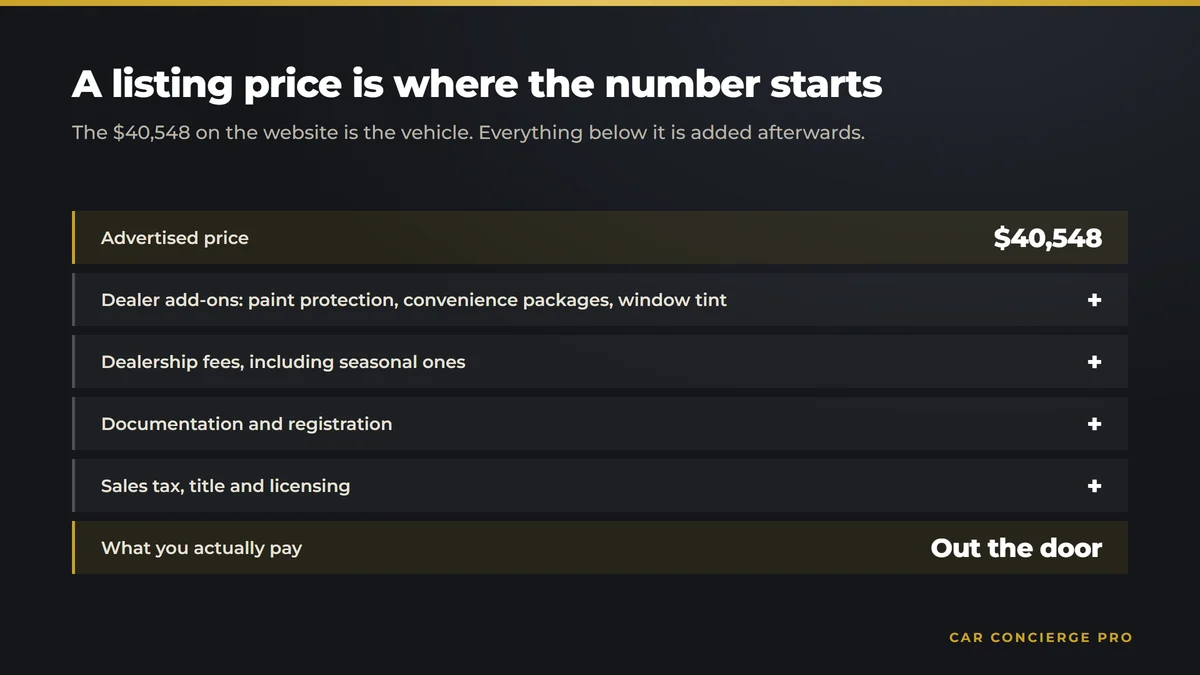
The client arrived with a listing he had found himself: a 2026 GR Corolla base at $40,548 on an Oregon dealership's website. That figure is where a negotiation starts, not where it lands. What sits on top of it:
- Dealer add-ons such as paint protection, convenience packages and window tint
- Miscellaneous dealership fees, including seasonal ones like a winter changeover charge
- Documentation and registration fees
- Sales tax, title and licensing
None of that is in the advertised number. On a car in this price band, the difference between the listing and the landed total is routinely four figures before anyone has negotiated anything. The CCP Out-The-Door Price Calculator runs that math on every shortlisted candidate so two cars can be compared on what they actually cost.
There is also the add-on question specific to a performance trim in demand. A car that sells itself invites a second sticker. The client's own summary of what he was trying to avoid was exactly that: "I was just trying not to pay second sticker."
How Wide Should a New-Car Search Be?
Wide enough that no single dealership is the only one who can sell you the car.
The search began at a 50-mile radius, then 100, then 200. It settled at 200 because the client named a second dealership outside the closer bands that he wanted included. That is the whole argument for radius in one move: at 50 miles he had one seller, at 200 he had several, and only the second situation is a market.
For a new car, the mechanics are straightforward. Every franchise dealership within the radius that has the right trim and one of the acceptable colors is contacted. Here the brief was the 2026 GR Corolla base, new only, in grey, white or black, in that order of preference, with the client noting he was easy on color if the right car turned up.
Color order matters more than it sounds. A single-color requirement narrows the pool, and a narrow pool costs leverage. Three acceptable colors in a stated order keeps the pool wide while still telling the team which car to push for when two are otherwise equal.
There was no trade-in on this engagement. He had already given his old Corolla to his brother, who needed a car.
What Is "Beat the Deal"?
It is the option for a buyer who already has a price: CCP only gets paid if it finds a better one.
The client opened the call with something most people would not say to a service they were about to hire. He did not think CCP could beat the price he had already found in Oregon, and he said so. He also said he would work with CCP regardless, for his parents' car later.
That is exactly the situation Beat the Deal exists for. If a buyer already has a deal in place on a specific make, model and trim, CCP will go to market against it. If the number comes back lower, the client pays. If it does not, there is no fee and no obligation. The risk sits with CCP rather than the buyer, which is only possible for a firm that is not paid by the seller.
How Does CCP Get Dealerships to Compete?
By collecting written quotes from several of them at once, stripping each one back to a clean price, and running multiple rounds.
The process Neel described on the call, in order:
- Identify every dealership in the radius with the right trim and color in stock
- Pull the window sticker for each specific vehicle, so the comparison is build data rather than listing copy
- Request a quotation by email, in writing, not a verbal "come on down"
- Strip out add-ons and markups until what remains is MSRP plus taxes and fees
- Put the clean offers side by side and take the best back to the others
- Run further rounds by call, email and text, pushing below MSRP toward invoice and then toward dealer cost
Step three is where most private negotiations fail. A salesperson promising a good price on arrival has committed to nothing. The instruction on this call was blunt about it: if the dealership wants to sell the car today, it gives a number that cannot be refused, and it puts that number on a dealership quotation sent by email.
The statistical side runs alongside it. Candidates are plotted price against mileage, with the median of each used to find where value for money actually sits rather than assuming the lowest-mileage car is the best buy. On a new-car search the plotting matters less than on a used one, but trim-level comparison still applies: sometimes the car between two trims is the better purchase, and that only shows up when the trims are priced side by side.
How Is the Engagement Structured and Paid?
A flat fee, agreed in writing, half at the start and half once the keys are in hand.
On this engagement the fee was $1,000 all-inclusive, split into $500 to begin the process and $500 after delivery. It is flat. It is not a percentage of savings, it does not scale with the price of the car, and CCP receives nothing from any dealership, which is what allows the recommendation to be "walk away from this one" at no cost to the firm.
Then the call did something worth recording. The client was straightforward about his money: the cash was his, it was in his account, and it would not clear until the 11th. He could not pay at kickoff. The answer was to start anyway, and to hold the invoice until the work had been delivered, so he could see the process before paying for it.
Current pricing across all service tiers is published at CCP pricing.
Does the Dealership Know a Concierge Is Involved?
No, not until the client decides to buy.
This is a deliberate part of the design, and on this call it was described as one of the two things a client is really paying for. The first is the price. The second is not being contacted. No dealership, including the ones in the client's own neighborhood, learns that a search is running until the final day, when the client says yes to a car and a number.
What that prevents is familiar to anyone who has filled in an online enquiry form: the calls, the texts, the follow-ups from six salespeople who now have your number. The engagement runs quietly, and the dealerships only find out afterwards that they were bidding.
What Stops the Price Changing at the Signing Table?
A line-by-line comparison of the negotiated figure against the final paperwork, before anything is signed.
A negotiated price is not a signed price. The gap between them is where a buyer's order grows by another $500 or $1,000, usually in items that look procedural. CCP checks the contract against the agreed numbers apples to apples, so the figure that was negotiated is the figure on the legal document.
The client knew why that step exists. His parents had been sold a warranty on a certified pre-owned car, a product whose value on an already-certified vehicle is close to nothing, with the pitch built on how expensive a battery is to replace. He was still angry about it. That anger is also why the next engagement, for his parents, was deliberately queued behind this one: he wanted to be able to show his mother a documented result first, so the second purchase would not feel like another leap of faith.
How Long Does a New-Car Engagement Take?
Around two weeks for a thorough search, with the first inventory options back within a day.
On this call the commitment was a first look at available inventory by the following afternoon, plus a personalised document for the client to work from. The client's own timeline was soft. He had a date in mind and no attachment to it.
Speed is possible when it has to be. The fastest engagement on record was completed in a single day, for a client whose car had been totaled and who needed a replacement the same evening; two team members were put on it and the car reached him that night. It is not the recommended way to buy a car. More time means more options reviewed, more rounds of negotiation, and dealership behavior that softens after several days of sustained pressure from a buyer who demonstrably has alternatives.
The Car Concierge Pro Difference
- No commissions, no dealer affiliations, and no payments from any manufacturer
- A flat fee agreed in writing before the engagement begins
- Beat the Deal: no fee unless an existing deal is beaten
- Written brief captured live on the first call, so filters apply from day one
- Window sticker pulled for every candidate, so comparison uses build data
- Written dealership quotations only, never a verbal promise
- Add-ons and markups stripped before any price is compared
- Out-the-door pricing calculated for every candidate, not just the headline price
- Final paperwork checked line by line against the negotiated numbers
- Complete confidentiality until the client commits, so no dealership outreach
Every engagement is backed by CCP's 30-day money-back guarantee. Terms and conditions apply.
Real CCP Client Savings
A snapshot of documented results across recent client engagements.
| Vehicle | Client Savings |
|---|---|
| Toyota Prius | $1,350 |
| Hyundai Tucson Hybrid | $3,500 |
| Lexus GX 550 | $3,800 |
| Lexus NX 350h | $4,500 |
| BMW X3 | $7,592 |
| Audi S5 Coupe Premium Plus | $8,070 |
Every result above was negotiated independently on behalf of a real client. Names and identifying details are withheld for privacy.
Sound Like You?
Common situations that sound like this one:
- You are buying a car as a gift and do not want the deadline used against you
- You already have a quote and want to know whether it is actually good
- You know how dealerships work and still do not want to spend your week on one
- You want a performance trim in demand without paying a second sticker
- You want every quote in writing before you visit anywhere
- You want one all-in number rather than a price that grows at the signing table
- You do not want six salespeople calling you for the next month
Every CCP engagement is backed by a 30-day money-back guarantee (terms apply).
FREQUENTLY ASKED QUESTIONS
1. Can you negotiate the price of a 2026 Toyota GR Corolla?
Yes, though a performance trim in demand negotiates differently from a volume model. The win usually comes from removing add-ons and markups and from making several dealerships quote in writing, rather than from a large discount off MSRP.
2. What is a "second sticker" on a new car?
It is a dealer-added markup or package list printed alongside the manufacturer's window sticker. It is not part of MSRP and it is negotiable, which is why comparing the manufacturer's sticker against the dealer's quote matters.
3. Should I buy a car for my child a year before giving it to them?
It is a reasonable approach. Driving it first means the early faults surface under the original warranty, and the car is handed over sorted rather than brand new, with coverage still running.
4. How far should I search for a new car?
Far enough that more than one dealership can sell it to you. A 50-mile radius often means a single seller; widening to 200 miles turns a single quote into a competitive one.
5. Does a car buying service get paid by the dealership?
CCP does not. The fee is paid by the client only, which is what allows the advice to include walking away. Any service compensated by a seller has an interest in the sale happening.
6. Will dealerships call me if I use a concierge?
Not during the engagement. Dealerships are contacted by CCP, not by the client, and they do not learn the buyer's identity until a car and a price are agreed.
7. Is a warranty worth buying on a certified pre-owned car?
Rarely. Certification already includes manufacturer-backed coverage, so an additional warranty often duplicates what is there. Read what the certification covers before accepting any add-on product.
Start Your Own Engagement
The right vehicle at the right price, with every number documented before you sign.
Schedule a complimentary 30-minute consultation.
Read more client journeys at Client Stories, or see what clients say at Client Reviews.
📞 +1 (480) 418-6390
🌐 carconciergepro.com
Every CCP engagement is backed by a 30-day money-back guarantee (terms apply).