








In this article
The dealership had exactly one G-Wagon on the lot. It was white. The client wanted black, and when he said so, the answer was that a custom build could be ordered and would arrive in February. Then came the number for the white one sitting there: $25,000 over sticker, because demand.
He turned both down, and he had a reason most buyers do not. He is moving from New York back to Poland late next year, and U.S. rules require him to own the vehicle for six months before he can export it. February delivery does not leave six months. He needed the right car, in the right color, quickly, and he was not paying a premium for the privilege. This is the discovery call that set that engagement up, including a paid-off Escalade that had to be turned into part of the purchase price.
When the Only Car in Stock Is the Wrong Color
A single-unit lot is not a market, and a dealer with one car has no reason to behave like one.
The client already owned several G-Wagons, all bought used. This time he wanted new. His local dealer's position was simple: here is the white one, here is the markup, or wait until February for yours. Neither answer had anything to do with what was available in the country; both came from what was available on that lot.
His own instinct was the right one. With hundreds of franchise dealers across the U.S., somewhere there is a black G63 with close to the right packages, already built, already sitting somewhere. The problem is not that the car does not exist. The problem is that finding it means calling two hundred dealerships and asking each one for a build sheet, which is not a thing a person with a job does.
Explore the full Car Buying Concierge service to see how a complete engagement is structured from the first call onward.
Behind Every Great Deal Is One Team. Meet Car Concierge Pro
Neel Mehta, founder and chief negotiator at CCP, is a TEDx speaker and a Biomedical Informatics graduate from Arizona State University.
CCP is an asset-light consulting firm. It owns no inventory, so there is no car it needs you to buy, and it takes no commissions, kickbacks or brokerage from any dealership or manufacturer. As Neel put it on this call, the model is closer to legal representation than to sales: a lawyer represents you, not the other side. The team has served 1,200+ clients, negotiated over $6.78M in client savings, and earned 122 reviews at a 4.8 rating. CCP is BBB A+ rated and holds two 2025 Corporate Vision Awards.
The team is 14 full-time people working Monday to Saturday, 9am to 6pm Eastern, across the USA, Canada and the UAE, with a founder-led standup every morning at 9. Each engagement gets one named associate concierge working it end to end.
Why a February Build Date Was a Dealbreaker
Because exporting a car out of the U.S. requires owning it first, and the clock on that cannot be shortened.
The client's move back to Poland is planned for late next year, and the vehicle has to be in his name for six months before it can be shipped. Order a custom build arriving in February and the six months do not finish in time. The deadline was not impatience. It was arithmetic.
This is worth noticing because it is a common shape of problem. A buyer with a hard external date, a relocation, a lease ending, a baby due, has less room than a buyer who can wait, and dealerships price exactly that. Handing the deadline to a team that can search nationally turns a short timeline from a weakness into a specification: the car must already be built, and preferably already on a lot.
The brief that came out of it was precise. A vehicle physically at a dealership, buyable now, or at worst an allocation landing inside 2026. Nothing beyond that.
Is $25,000 Over Sticker Ever Justified on a G63?
Not in this market, and the client had done the homework to prove it.
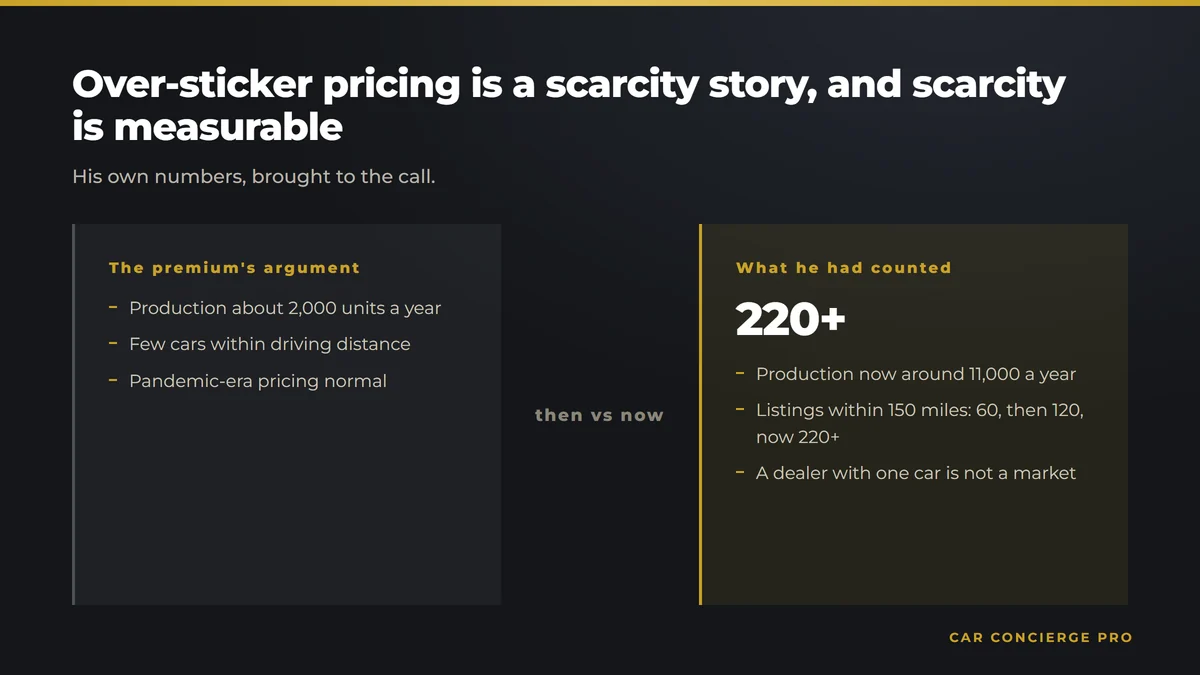
He follows the segment as a hobby, and he brought numbers. Mercedes used to build roughly 2,000 G-Class units a year; production has risen to around 11,000. On the supply side he had been watching listings within 150 miles of home for years: about 60 for sale a couple of years ago, around 120 last year, and more than 220 now.
That is the whole argument in two lines. Over-sticker pricing is a scarcity story, and scarcity is measurable. When the number of cars for sale within a two-hour drive has more than tripled, the scarcity has gone, whatever the salesperson says about demand.
The dealer's pitch leaned on the pandemic years, when paying over sticker was normal. It is not 2021. On a car like this the realistic target is sticker or below, not sticker plus a five-figure premium, and the way you get there is multiple dealerships quoting against each other rather than one dealership explaining itself.
Why the Configurator Does Not Show Every Option
Because the manufacturer's website and the real order bank are not the same list.
The client built his ideal car on the Mercedes USA site and hit the limit of it immediately. The interior color he wanted was not offered. Three were: black, gray and white. No red, no beige. He had seen those colors in person at a dealership, and the European site offered far more than the U.S. one. Options also vanished between visits while the site was being worked on.
So a buyer comparing listings is working blind twice over. The configurator understates what can be ordered, and the listing sites do not state which packages a given car actually has. A used-car listing for a G63 will rarely tell you whether it has the carbon package or the AMG package.
What closes that gap is the window sticker and the build document, pulled per vehicle. The client had a build he could export from the Mercedes site as a PDF or share as a build code, and that goes to the team as the specification. Every candidate then gets checked against it, from the dealership's own paperwork rather than from listing copy.
How Do You Search for a Specific Build Across the Country?
By starting with a radius and then widening it until the right specification appears, across far more than one listing site.
The search runs over 18-plus platforms, including Autotrader, Autolist, CarGurus, KBB and Carfax, not just the one most buyers use. The radius starts at 50, 100 or 200 miles and keeps expanding, because a color-plus-package brief cannot be satisfied from a small pool.
Each candidate is recorded in a live Google document shared with the client and updated as the search runs, with a column per thing that matters: packages, mileage, model year, depreciation against MSRP, distance, and the cost of getting it home. For a pre-owned candidate the depreciation column does the deciding. A 2025 car with 5,000 miles that has only lost $1,000 off MSRP is not a bargain. A 2022 car with 20,000 miles that has lost $25,000 might be.
Nothing is bought on a listing alone. A pre-owned candidate gets a pre-purchase inspection, a Carfax and AutoCheck report, and the dealership's own inspection report in writing.
Should You Trade the Escalade or Sell It Separately?
Whichever leaves the smaller gap between the two numbers, and that has to be calculated rather than assumed.
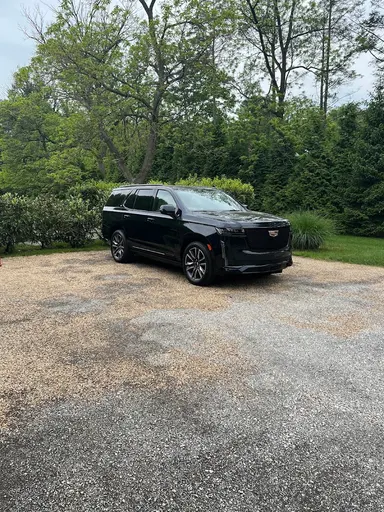
The client had a 2021 Cadillac Escalade Sport Platinum with 80,000 miles, paid off years ago. There are two routes, and a trade is not automatically the worse one, because of tax. In most states you pay sales tax on the purchase price net of the trade. On a car worth $50,000, that exemption alone is real money, and it has to sit in the comparison alongside the higher gross price a private sale might fetch.
So the analysis is run both ways. Buy independently and sell independently: what is the net out of pocket? Buy and trade at the same dealership: what is the net out of pocket, tax saving included? The route with the smaller net difference wins. Buy at the lowest negotiated price, sell at the highest achievable price, and keep the gap between them as small as possible.
The CCP Out-The-Door Price Calculator runs the purchase side of that math on every shortlisted candidate.
Why the trade is revealed last
A trade disclosed early becomes a discount the dealership gets to spend.
The sequence on this engagement was deliberate. Negotiate the G63 to its floor first, with no mention of an Escalade. Only once the purchase price is settled does the question go out to every one of those dealerships: there is a trade, what is your best number for it?
That keeps the two negotiations from being blended, which is where a generous-looking trade figure quietly funds itself out of a withdrawn discount. Then the offers are compared on net cost. One dealer at $250,000 for the G63 with $50,000 for the Escalade leaves $200,000. Another at $260,000 with the same $50,000 leaves $210,000. Same trade value, ten thousand dollars of difference, and the only way to see it is to put both on one line.
For a straight sale the Escalade's details, VIN, mileage, trim, packages, condition and title, go out to dealerships who bid for it without knowing whose car it is, and the top three written offers are compared. One constraint applies either way: the Escalade does not get shipped more than about 500 miles. Once your car is a thousand miles away, the buyer at that end sets the terms.
Trading in? Car Concierge Pro's trade-in service runs that side as its own negotiation.
The Sales Tax Line Nobody Checks
Sales tax is a rate set by your state and county, not a number the dealership decides, and it is worth reading.
One of the quieter things raised on this call: some dealerships add roughly a percentage point to the sales tax line, charging 10% where the rate is 9%, so the salesperson's commission comes out of the buyer's money rather than the dealership's. Most buyers have no idea what their actual combined rate is, so the line passes unexamined.
On a six-figure car, a single point is four figures. This is why the number that gets negotiated is the out-the-door price, in writing, with every line itemized, and why the final contract gets compared against it before signing. A fifteen-page document is a lot of places for a price to change.
What Does the Engagement Cost, and When?
$1,500 all-inclusive on this engagement, covering both the purchase and the Escalade, with most of it payable only after delivery.
The split was $500 at kickoff and the remaining $1,000 once two things had happened: the G63 keys were in his hand, and the Escalade had been sold or traded with the value actually received. Not at signing. Not at an agreed price. After the money landed.
The fee is flat, agreed in writing, and does not scale with the price of the car, which on a G63 matters more than it sounds: a percentage-based fee would have an interest in a bigger number. CCP takes nothing from any dealership, which is what allows the advice to be "walk away from this one".
Current pricing across all service tiers is published at CCP pricing.
How Long Does It Take?
As fast as the inventory allows, with the brief here being a car already built rather than one to be ordered.
Because the specification was "on a lot now, or allocated inside this year", the timeline was bounded by what exists rather than by a factory. Candidates in transit, candidates on allocation and candidates physically at a dealership all get presented with their trade-offs, and the client picks.
Over-sticker is not a given, even on a car in demand. A recent client came to CCP having already spent six months trying to buy a Lexus at MSRP, and set the condition plainly: get it at MSRP or refund the fee. It was bought at MSRP.
The Car Concierge Pro Difference
- No commissions, no dealer affiliations, and no payments from any manufacturer
- A flat fee agreed in writing, most of it payable only after delivery
- Search across 18+ listing platforms plus direct dealership sourcing
- Search radius expanded until the specification is met, not capped at a drive
- Build document and window sticker checked per vehicle, not listing copy
- Depreciation against MSRP calculated for every pre-owned candidate
- Out-the-door price in writing, itemized, before any visit
- Purchase negotiated to the floor before a trade is ever mentioned
- Trade and private-sale routes compared on net cost, tax saving included
- Pre-purchase inspection, Carfax, AutoCheck and the dealer's own report
- Final contract checked line by line against the negotiated numbers
- Shipping quoted and coordinated, paid directly to the carrier
Every engagement is backed by CCP's 30-day money-back guarantee. Terms and conditions apply.
Real CCP Client Savings
A snapshot of documented results across recent client engagements.
| Vehicle | Client Savings |
|---|---|
| Hyundai Tucson Hybrid | $3,500 |
| Lexus GX 550 | $3,800 |
| Lexus NX 350h | $4,500 |
| BMW X3 | $7,592 |
| Audi S5 Coupe Premium Plus | $8,070 |
| Mercedes-Benz S500 4MATIC | $22,334 |
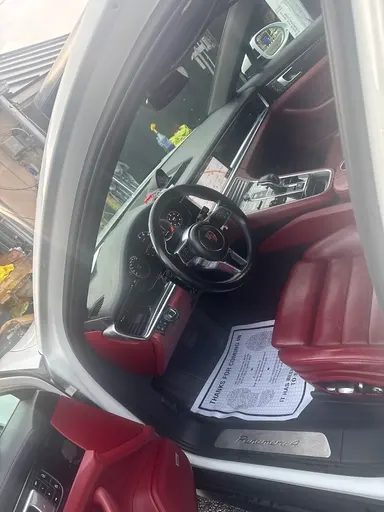
| Porsche Panamera 4S | $52,337 |
| Bentley Bentayga EWB | $60,174 |
| Rolls-Royce Ghost | $111,368 |
Every result above was negotiated independently on behalf of a real client. Names and identifying details are withheld for privacy.
Sound Like You?
Common situations that sound like this one:
- Your local dealer has one example of the car, in the wrong color, at a markup
- You are being asked to pay over sticker and do not believe the scarcity story
- You have a hard date, a relocation or an export window, and a build date that misses it
- You want specific packages and cannot tell from listings which cars have them
- You have a paid-off vehicle and do not know whether to trade it or sell it
- You want the purchase settled before the trade is discussed
- You want one itemized out-the-door number, checked against the contract
Every CCP engagement is backed by a 30-day money-back guarantee (terms apply).
FREQUENTLY ASKED QUESTIONS
1. Do you have to pay over sticker for a Mercedes-AMG G63?
Not in a market with this much supply. G-Class production has risen from roughly 2,000 units a year to around 11,000, and listings have multiplied in most metros. Over-sticker asks come from single-unit lots, not from the national picture.
2. How long must you own a car before exporting it from the U.S.?
Six months, which is why a build date months out can rule a car out entirely for anyone planning to ship it abroad. Confirm the current requirement with U.S. Customs and Border Protection before committing to a delivery date.
3. Why does the manufacturer's configurator not show every color?
The site's option list and what can actually be ordered or found in stock are not the same. Interior colors in particular come and go on the U.S. configurator while the European site shows more. Build documents and window stickers are the reliable source.
4. Is it better to trade in a paid-off car or sell it privately?
It depends on the tax. Most states charge sales tax on the price net of a trade, so a trade can beat a higher private offer once that exemption is counted. Run both routes and compare the net out of pocket, not the headline figures.
5. Should you mention a trade-in at the start of a negotiation?
No. Settle the purchase price first. A trade raised early lets the dealership move value between the two numbers, which is how a strong trade figure ends up funded by a discount that quietly disappears.
6. What should you check on the sales tax line of a car contract?
Your actual combined state and county rate. Some dealerships add about a percentage point to cover the salesperson's commission, and on an expensive car that single point is four figures.
7. How do you find a specific build of a car across the country?
Search more than one listing platform, keep widening the radius until the specification appears rather than the other way round, and verify packages against each vehicle's build document instead of the advert.
Start Your Own Engagement
The right vehicle at the right price, with every number documented before you sign.
Schedule a complimentary 30-minute consultation.
Read more client journeys at Client Stories, or see what clients say at Client Reviews.
📞 +1 (480) 418-6390
🌐 carconciergepro.com
Every CCP engagement is backed by a 30-day money-back guarantee (terms apply).