




In this article
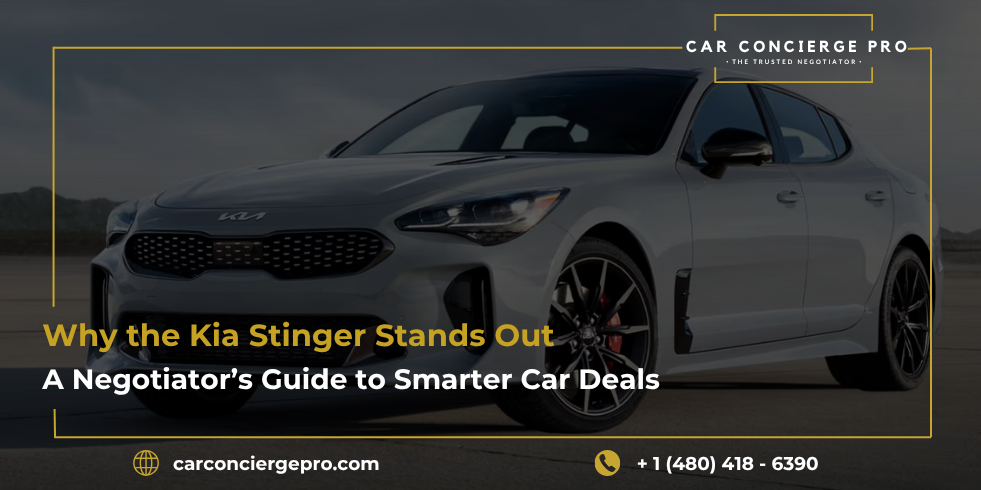
The Kia Stinger was the car buyers had to look at twice, because the badge on the tailgate did not match the shape underneath. Long nose, short rear deck, rear-drive proportions, a twin-turbo V6 in the quick versions, and a hatchback hiding under what looks like a trunk lid. Kia built it from the 2018 model year and stopped after 2023.
That last fact changes everything about how you approach one now. You are not ordering a Kia Stinger. You are buying somebody else's performance sedan, several years old, quite possibly driven the way it was engineered to be driven. That is a different negotiation from a new-car deal, and the inspection matters as much as the price.
What Made the Stinger Unusual?
Kia had not built a sports sedan before this one and has not built one since. It sat on a rear-drive-biased platform shared with the Genesis G70, its chassis was developed under engineers hired out of BMW's M division, and its proportions were European grand tourer rather than the upright three-box shape of its rivals.
Three things made it genuinely distinct:
- The layout. Rear-wheel drive standard, all-wheel drive optional. Very little else in its bracket offered that.
- The tailgate. It looks like a sedan and opens like a hatchback. Load space is closer to a small wagon than a sedan, which is a daily advantage rather than a spec-sheet one.
- The engine ceiling. GT trims used a 3.3-liter twin-turbo V6 making roughly 365 horsepower through an eight-speed automatic, good for mid-four-second acceleration to 60 mph.
It never sold in large numbers. That is exactly why it is interesting used.
Why Is This Now a Used Purchase Only?
Production ended after the 2023 model year, which closed with a limited Tribute Edition run. There is no direct successor; Kia moved its performance attention to the EV6 GT.
So every Stinger on the market is a used car, and three rules change accordingly:
- Condition and history now outrank trim and color.
- The headline ten-year/100,000-mile powertrain warranty belongs to the original owner only. A second owner inherits the shorter five-year/60,000-mile term, measured from the original in-service date, so on the earliest cars nothing remains. Check the position by VIN before you decide what the car is worth.
- Nobody is offering you factory finance or a manufacturer rebate. Your rate comes from your own bank or credit union and is set by your credit tier and the age and mileage of the car, so carry a written pre-approval in before you shop. Values move the same way: mileage, service history, whether the car was modified and what your region actually pays for a low-volume performance sedan matter more than any model-wide average, so price the specific car in front of you rather than the model.
GT-Line or GT: Which Engine Is the Real Decision?
Trim names moved around across the production run, but the decision underneath never changed: four cylinders or six.
| Version | Engine | Drivetrain | What you are really buying |
|---|---|---|---|
| Base / Premium / GT-Line (2018–2021) | 2.0 L turbo four, roughly 255 hp | RWD standard, AWD optional | The shape, the hatch and the ride — not the drama |
| GT-Line (2022–2023) | 2.5 L turbo four, roughly 300 hp | RWD standard, AWD optional | A meaningfully quicker four-cylinder car |
| GT / GT1 / GT2 | 3.3 L twin-turbo V6, roughly 365 hp | RWD standard, AWD optional | The engine the car was designed around, plus Brembo brakes and adaptive dampers |
Be honest with yourself here. The four-cylinder cars are good cars: comfortable, practical, quick enough, cheaper to insure and to run. But most people who want a Stinger want the V6, and the four-cylinder is the version they are quietly disappointed by six months later. If the V6 is what you actually want, buying the cheaper car to save money is usually the more expensive decision.
The reverse holds too. If your driving is twenty miles of city traffic a day and the performance will never be used, the 2.5-liter GT-Line is the smarter purchase and we will tell you so.
CCP advantage: we shop the specification you actually want across a wide geographic radius, not the one car that happens to be local. On a discontinued, low-volume model the gap between "the one nearby" and "the right one" is often several states wide, and buying out of state is routine for us.
What Should You Inspect on a Used Stinger?
This is a turbocharged performance car. Assume nothing. An independent pre-purchase inspection — not the selling dealer's own shop — is not optional, and we arrange one on every performance car we buy.
What we ask the inspector to concentrate on:
- Service history in documents, not stickers. Turbocharged direct-injection engines punish deferred oil changes. Gaps in the record are a price argument at best and a reason to walk at worst.
- Turbo health. Whine or flutter, oil in the intake tract, smoke on a hard pull once warm, and any oil consumption between services.
- Evidence of modification. Tunes, piggyback boost controllers, downpipes, intercoolers, exhausts. A modified car has by definition been driven hard and is worth less than a standard one however good the parts are. Look for tool marks and mismatched hardware.
- Brakes and tires. GT cars use Brembo brakes and often staggered tire sizes, which cannot be rotated. Replacement cost is large relative to the price of the car, and worn examples are a direct negotiating item.
- Accident history, then a paint gauge. A clean report is not the same as no damage. A paint depth gauge takes two minutes and finds repairs that never reached a report.
- The eight-speed automatic and the AWD system. Harsh or hunting shifts, and any driveline vibration under load.
- Adaptive dampers on GT trims. Expensive to replace. Confirm the drive modes genuinely change the ride rather than just the instrument graphics.
If two or more come back poor, the right answer is usually not to buy that car. Another one exists.
Does Discontinuation Help You or Hurt You?
Both. Be clear-eyed about each side.
| Works in your favor | Works against you |
|---|---|
| No new-model marketing propping up demand, and thin demand is negotiating room | Residual values are harder to predict for a model with no successor |
| No new inventory competing, so a dealer holding one usually wants it gone | Enthusiast interest can hold clean, low-mileage GT cars above the rest of the market |
| Parts flow through the Hyundai/Kia network and the platform is shared with the Genesis G70 | Model-specific trim, body panels and interior parts get scarcer each year |
| Independent specialists know these cars well | Franchise dealers increasingly do not — find an indie before you buy, not after |
The shared platform is the part most buyers miss. Mechanically this is not an orphan: the drivetrain and much of the hardware under it live on in Genesis products.
What Does a Used Stinger Cost Out the Door?
The advertised price is not the number you pay, and on a used car the fee menu is longer: documentation, reconditioning, dealer-installed add-ons, certification premiums, then tax, title and registration.
Work out the total before you speak to anyone, with our out-the-door price calculator. Then keep three negotiations apart rather than letting the desk blend them:
- The price of the car. Agreed first, in writing, before anything else is discussed.
- Your trade. Valued independently and by more than one buyer, after the purchase price is settled. A generous trade figure is the most common way a good price is quietly taken back.
- Finance and the back end. On a used turbocharged car an extended warranty can be genuinely worth having, but never at the first price quoted and never folded silently into a monthly payment.
How Does CCP Negotiate a Used Performance Car?
We are paid a flat fee by you and take no money from any dealer. That is the whole reason we can tell you to walk away from a car you have already fallen for.
On a used Stinger, our car buying service means we:
- search nationally for cars matching the exact specification, rather than settling for what is close by;
- pull and read the full history on each candidate before you spend any time on it;
- commission an independent pre-purchase inspection and use the findings as leverage, not as reassurance;
- price the car against real regional transaction data instead of asking prices;
- value your trade separately through multiple buyers, so the two numbers cannot be played against each other;
- read the final paperwork line by line, which is where removed fees reappear.
You never sit at a dealership desk, and you learn what the car is worth before anyone asks what you can pay per month.
Book your free consultationFrequently Asked Questions
- Can I still buy a new Kia Stinger?
No. Production ended after the 2023 model year and there is no successor. Anything still advertised as new is leftover stock and vanishingly rare. Plan on a used purchase and price it that way.
- Is the four-cylinder Stinger fast enough?
For ordinary driving, yes, and the 2.5-liter fitted from 2022 is noticeably stronger than the earlier 2.0-liter. But the car was designed around the twin-turbo V6, and buyers who wanted the V6 and settled for the four rarely stay happy.
- Are Stingers expensive to run?
Routine servicing is priced like a Kia. Consumables on a GT are priced like a performance car: Brembo pads and rotors, staggered tires that cannot be rotated, and oil changes that should not be stretched. Budget for the consumables, not the badge.
- Should I avoid a modified Stinger?
Usually, yes. A tune or a downpipe tells you how the car has been driven, complicates any remaining warranty claim, and narrows your future resale audience. If you buy one anyway, it should be priced well below a standard example, not at a premium for the parts.
- Does the ten-year Kia warranty come with the car?
Not for you. The ten-year/100,000-mile powertrain coverage applies to the original owner. A subsequent owner gets five years or 60,000 miles from the original in-service date, so on early cars nothing remains. Confirm by VIN before you agree a price.
- How does Car Concierge Pro help on a used car rather than a new one?
Used is where our work matters most, because there is no fixed sticker to argue against. We find the right examples nationally, verify condition independently, price against what these cars actually transact for, and handle the trade separately. Our fee is flat and paid by you, so we have no reason to talk you into a car.